Welcome to ‘Between the Lines’ – interviews with teachers, writers and writing teachers on specific aspects of their craft. This interview was split into two posts to do justice to Madenski’s generous sharing of time and wisdom. Part 1 covered her biography and writer’s origin story. Part 2 focuses on craft and teaching.
How does one identify the seed of a piece of writing?
Surprise. My Achilles heel is that I get too sentimental. The more sentimental writing gets, the greater the distance. When you write universally, describe, and keep those emotions out, you open it up.
What questions should a writer ask themselves at the beginning of a piece?
- Know?
- Don’t know?
- What to know?
It’s about finding [one’s] curiosity.
What should a writer consider, and disregard, when beginning a piece of writing?
The first step is not creating a story. The first writing, what we used to call free writing, is first thoughts. It frees you from having to be worried about the things you might worry about in a final draft.
One of my small rants is that free writing became a thing, and teachers sit children down and make them write. Once something becomes institutionalized, it’s difficult for students to feel safe with it. If you look at writing as a place to explore, to find meaning, it becomes a different thing.
Why is working through first thoughts important?
A student I loved told me she wrote about a problem she had for five days in a row. The first version was awful, full of blame; after five days, she’d narrowed it to what she could change and what she couldn’t. That was never going to be published, but that is the writing process.
As an adult, I started [writing] the first day after [my husband] Mark died. Those journals were useless – they were just questions. In two full journals, there are probably two salvageable sentences. But it helped me to be a better parent, to get through that.
How important is defining an audience?
I never do until the end; maybe not even then. I write what I’m curious about and if I have that intuitive sense, if it feels good, I’ll keep working. After I finish, then I’ll think of where to send it.
How can writers get better at finding seeds? And drafting?
They get better as they practice, as with anything else. Writing, and maybe this is true of dancing and photography, offers lots of rewards when you start to use it across the arc of your life.
What opportunity does writing bring the writer?
The chance to see things more clearly. The opportunity to notice, to slow, to look. I wrote a poem called ‘Ode to Black’, during the Black Lives Matters protests. I was walking one day and there were crows everywhere. And I walked to the creek and the ducks have this black so black it’s almost indigo on their faces. So much of what I love in nature is black – trees in winter – so I wrote this poem.
Writing has given me knowing what I want to get good at; stability, better understanding of myself, much better understanding of students. I love publishing, but it wouldn’t stop me writing if I didn’t publish.

Madenski recommends
The piece of writing that changed your life before age 18?
‘The Raven’ by Edgar Allen Poe, which I memorized in sixth grade. And Robert Frost, ‘The Road Less Taken’, reading them, something shifted in me.
The piece of writing that changed your life as an adult?
Early Morning by Kim Stafford. It’s a very personal book [about his father], but it’s universal. It helped me see people as complex and beautiful. You can struggle with someone or something, but still see the beauty in them.
A classic you would love to teach?
My Antonia by Willa Cather. I don’t go around thinking of myself as a feminist, but I am a feminist. Willa Cather cut her hair, wore pants, got a job as a journalist. It is beautifully written and would be a perfect thing to teach. To have [students] read the book first, and not know about her, then fold in her influences as a woman writer when it wasn’t easy to be one. That would open up some wonderful conversations.
A contemporary work you would love to teach?
Happiness by Aminatta Forna. It’s about two characters in their late adult years, their children are raised. They have experience; they’ve lived hard lives, and that is part of the story too. The book is complicated: it’s about where we are in the world, our relationship to animals, the divisiveness that pulls us apart. It’s about aging, what it means to have loved, to have a long career. It is about a different type of happiness.
A book about writing every writing student should read?
The Crafty Poet: A Portable Workshop Vols I, II & III by Diane Lockwood. I wish I’d found these [books] years ago.
A visual artist/musician/film maker who inspires you?
Greta Gerwig. She’s a great example of how we can come to stories about love, friendship, culture, with a different lens. She started out independent with Lady Bird and Little Women, then the Barbie movie, which I wasn’t going to see because of my assumptions. But I went and I loved it. [Gerwig] has a different voice, a way of storytelling that is the opposite of what I thought it would be.
A book you buy copies of to give to friends?
Who Dies? and Unattended Sorrow, both by Stephan Levine. They are about grief. At this time in my life, people are losing big things – parents, children, partners. Levine writes about compassion, in its true sense. Looking through a lens at the hardest things in our lives. I soak up instruction in how to endure difficult things. It’s not an exercise in denial, it’s an exercise in facing.
What’s next?
Inspired by Ada Lemon’s linked sonnets in The Lucky Wreck, I am working on seven verses that began with a walk on the Columbia River. I saw an asylum of loons and that’s where the poem started. It’s not ready to read aloud yet, but it’s going somewhere good.
I’m also working on an essay about ageing, and pulling together poems for a reading with Andrea Carlisle at Broadway Books on 5 September.
Not least, I walked Neskowin Creek [near my old home] from the headwaters to the coast. I had been teaching all summer, couldn’t afford to travel and needed to do something, so I walked. I collected about 80 pages of field notes. [My daughter] Hallie and I, will go in the fall and she’ll photograph it. Then I’ll publish that, maybe.
Connect
Web:
- Her Photos, My Poems (a collaboration with daughter Hallie Madenski)
Books:
- Field Notes (with Hallie Madenski)
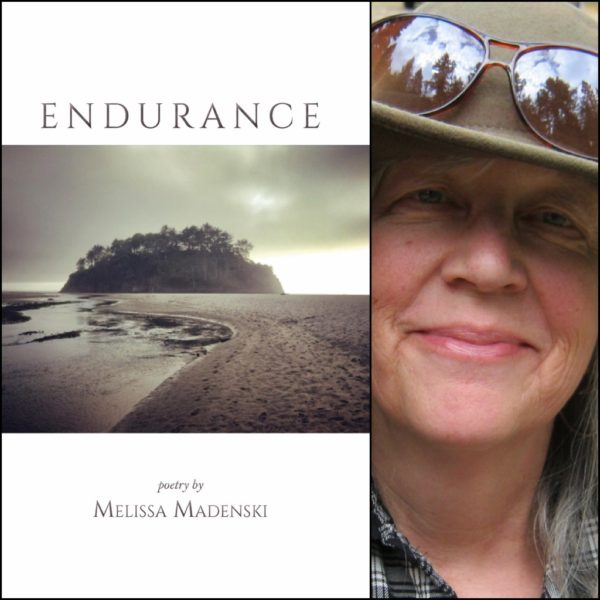
- Endurance
Events:
- In conversation with Andrea Carlisle at Broadway Books, Portland, OR. 5 September, 2023


 Cila Warncke Writer