On Generous Writing

Photo by Ben White on Unsplash

Life never ceases to be difficult, to paraphrase Rilke. Amidst its slings and arrows, there is often little to comfort and guide.

Without generous writers, there would be almost nothing.

Among recent difficulties faced by myself, or someone I love: bereavement, major surgery, significant medical diagnoses, divorce, conflict with parents, conflict with children, unemployment.

These are not remarkable events, statistically. Yet, to the individual, they are as life-altering as Krakatoa. If anything, the cognitive dissonance of knowing the event to be universal versus the all-consuming personal experience of trauma makes it harder to cope.

We need wise friends to walk these dark halls. But unless we’re lucky, and our friends unlucky, we are not likely to find the necessary wisdom in our immediate social circle. Shared experience can as easily drive a wedge as forge a bond.

Into this gap step writers whose words offer perspective without judgment, comfort without reciprocity and infinite patience. They sit at our bedside in the small hours, walk with us, accompany us raging, glum, drunk, frustrated or frightened.

Their generosity lies in a willingness to delve into the most difficult parts of their lives and, through grit and creativity, distill their thumb-screwed wisdom into something readers can use.

Photo by Wai Siew on Unsplash

Imagine being lost at sea on a leaky boat. Most of us would consider feel heroic merely staying alive. But a writer would be thinking: how can I help the next person who finds themselves out here?

They would be jotting notes about tides and winds, describing how to make a fishing line out of dental floss, giving tips on bailing and load-balancing.

Although this sense of purpose may be sustaining, it does not mean the work is easy. The generosity of writers lies in their willingness to labor during their most difficult experiences to give hope to those caught in similar currents.

The following are seven books that exemplify this generosity: all by women, whose emotional work is routinely undervalued, on the page and elsewhere.

Seven Generous Books

The Elements by Kat Lister
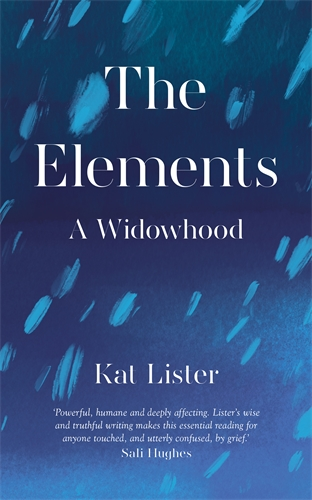
Most couples in their 30s are settling into their first homes, thinking about kids; Kat Lister and her husband, Pat Long, did those against the ticking clock of his brain tumor, which was discovered before their wedding. They lived the few years they had together with uplifting, illuminating grace. When he died, Lister was left to navigate the anachronisms of young widowhood, a trial by water she recounts here with bold, Didion-esque honesty.

Buy

Transcendent Kingdom by Yaa Gyasi

Generosity is not constrained by genre. While we may assume that memoir has the most to teach, the ruthless craft required of good fiction offers equal — or even greater — opportunities. This novel, which begs to be described by its titular adjective, unpicks grief, addiction, survivor’s guilt, and the complicated strands of rejection, assimilation, belonging and othering woven into immigration, racism and religion.

Buy

A Three Dog Life by Abigail Thomas

Perhaps the only thing more appalling than the death of a partner is losing a partner in mind, not body. Thomas’s memoir invites the reader into the Kafka-couldn’t-dream it surreality of life following her husband’s traumatic brain injury (TBI). Along with grief, come care decisions, guilt, frustration, and no one to share the challenges.

Buy

Why be Happy When You Could be Normal? by Jeanette Winterson

Read this with its fictional counterpart, Winterson’s debut novel, Oranges Are Not the Only Fruit, to fully appreciate her generosity and courage. By the time she wrote this memoir, Winterson was a revered literary figure and bona fide success story. To admit, from that height, to the haunting power of childhood trauma could have seemed an admission of weakness. Her vulnerability is potent and empowering.

Buy

Nomadland: Surviving American in the 21st Century by Jessica Bruder

Please read the book; the film (brilliance of Frances McDormand notwithstanding) does it no justice. Nomadland exhibits another form of authorial generosity: the willingness to put one’s life aside to bear witness to the lives of others that would otherwise go unrecorded. The crushing, mechanistic cruelty of late capitalism comes to vivid life through Bruder’s painstakingly reported account of life on the dusty, bald-tire fringes of the so-called American dream.

Buy

A Manual for Cleaning Women by Lucia Berlin

Every time I pick up A Manual, I wind up reading it all the way through. Berlin’s autofiction is enthralling, terrifying, devastating on multiple levels. The writing is almost too sharp and bright to look at (forget window pane, this is prose as emergency flare) which is necessary magic given the gut-punch tales it tells. Stuff that in lesser hands, or played straight, would be unendurable, is transmuted into stories that soar and hover on the thermals of your mind.

Buy

Foreverland: On the Divine Tedium of Marriage by Heather Havrilesky
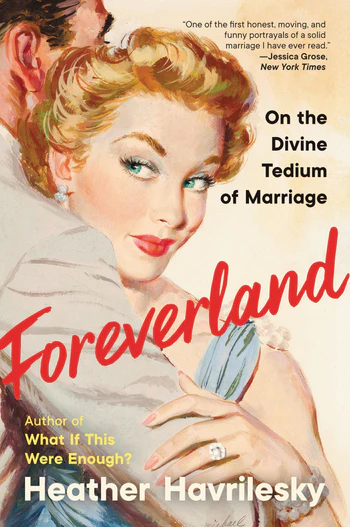
It is one of life’s slipperiest tricks that the things we’re taught to crave and cherish are (surprise!) headaches too. Marriage, at least happy marriage, is perhaps the quintessential sacred cow; the immutable good thing one should pursue without question. Thank goddess, then, for Havrilesky who seems to operate from the position that sacred cows are best served medium-rare. Her brave assertion of the inconvenient truth that true love and explosive exasperation are not mutually exclusive is a pinpoint of light in what might otherwise be a suffocating dimness.

Buy

What are your life-boat books? Share in the comments!

On AI: Artificial Ignorance

Artificial intelligence promises to augment our collective processing capacity. But on an individual level it is a neurotoxin that promises learners only artificial ignorance.

We are all familiar with the fact that unused muscles weaken, then atrophy. If one were to permit a developmentally normal, able-bodied child to rely on mobility scooter for transport they would, over time, develop physical incapacity where none had existed: an induced disability.

Photo by lilartsy on Unsplash

Thus, it shouldn’t be difficult to grasp that permitting children to rely on artificial intelligence ‘assistance’ such as ChatGPT will weaken, then atrophy, their intellectual capacity: an induced disability.

Writing a better brain

Writing is not just the product of thought. It has a unique ability to generate thought.

  • ‘I write entirely to find out what I’m thinking’ ~Joan Didion, journalist.
  • ‘With each of the new [ancient] writing systems, with their different and increasingly sophisticated demands, the brain’s circuitry rearranged itself, causing our repertoire of intellectual capacities to grow and change in great, wonderful leaps of thought.‘ ~Maryanne Wolf, Director of the UCLA Center for Dyslexia, Diverse Learners, and Social Justice.

As Wolf explains in her 2007 book Proust and the Squid (from which the above quote is taken) there is neither gene nor discrete neurological structure that enables humans to read and write. Literacy relies on complex, non-axiomatic collaborations between a variety of perceptual and cognitive systems.

Put another way: preliterate and literate brains are structured the same. What changed human history was not a novel biological development but the recruitment of extant neurological capabilities to perform a novel task.

Does that bend your mind a little?

It should.

Writing is not just a means of expression, like speech. It is a process and practice that improves cognitive function; it rewires the brain.

Put another way: it isn’t that smart people are better writers, it’s that writing makes people smarter.

Photo by Santi Vedrí on Unsplash

All of us who care about children’s long-term well-being, whether they are our students or offspring, should be anxious to help them develop their fullest intellectual capacity.

We are on a hot rock spinning towards oblivion. Life for kids who are in today’s classrooms will be complex beyond the wildest imaginings of us scions of the analogue order. The will need to be wily, resilient and resourceful AF.

Being laissez-faire about kids substituting artificial intelligence for study makes as much sense as being laissez-faire about children playing with live hand grenades: cool, if you don’t mind the maiming.

There are three key reasons I won’t use generative AI and emphatically discourage its use by students.

Neural stunting

A well-used brain grows, according to Pauwels et al. (2018):

“Practice leads to improvement in and refinement of performance… and this dynamic behavioral process is associated with altered brain activity…. Besides functional brain changes, practice also induces structural changes, such as alterations in regional brain grey and white matter structures.”

A brain that does not practice complex skills fails to grow, just as the disused muscle slumbers undeveloped. The brain becomes stunted compared to what it could have been, could be, with training.

A less-developed brain with fewer neural connections and reduced processing efficiency does not just affect reading or writing skills. If affects a person’s ability to learn, communicate and adapt.

Every time a student outsources their thinking to AI, they are sabotaging their long-term mental flexibility.

Educators and parents bear responsibility for this, insofar as we perpetuate a results-based learning environment. When we prioritize the ‘right answer’, kids get the message that process doesn’t matter. It makes sense for them to use any means necessary to get the answer that gets the desired grade.

We grown-ups need to rewire our thinking and explicitly focus on the learning process. This is not going to be easy, given the baggage of 150-odd years of rote education, but we have to begin. This might be as simple as grading the steps of an essay instead of the final draft, or doing away with grades altogether in favor of a feedback system. (For more ideas: Ungrading with Anthony Lince)

Photo by Markus Spiske on Unsplash

Concentration of intellectual capital

Late-capitalism has succeeded in concentrating financial capital into the hands of a vanishingly small number of individuals. The grotesqueries of this are felt every time an ordinary US citizen needs insulin or an EpiPen, or wants to go to college. There are felt a thousandfold-moreso by the 650 million people living in extreme poverty around the globe.

This concentration accelerated wildly during the Covid-19 pandemic: ‘Billionaires’ wealth has risen more in the first 24 months of COVID-19 than in 23 years combined,’ Oxfam reported. ‘The total wealth of the world’s billionaires is now equivalent to 13.9 percent of global GDP.’ 

Put another way: those of us not born to oligarchy face ever-slimmer chances of rising to the top. Financially, anyway.

Until now, those not to the manor born could at least, to paraphrase Britpop’s finest cynic, Jarvis Cocker, use the one thing we’ve got more of: our minds.

Unless we allow kids to consign their thinking skills to artificial intelligence.

To be clear, I don’t believe there is a conspiracy among Musk, Zuckerberg, et al. to make the rest of the population dumber so they can rule in full-blown, unchecked Bond-villainesque splendor (mwah haha).

But there is a real danger of that dystopia becoming a reality through lack of vigilance on the part of educators, parents and politicians.

Big tech does not care about us. Does not exist to serve us. Is not our toy.

In the same way wealth-accumulation takes on a life of its own, with money begetting money, intellectual capital accretes to the intellectually adept. Students who read, write and think critically enhance the neural circuits for these skills, gaining efficiency, automaticity and self-confidence.

This enables them to tackle bigger challenges, be more creative, rise to the top. The better they get at learning, the more dauntless they will be; the more quickly they will evolve to meet new demands.

Students who let AI think for them will cultivate artificial ignorance, sap their innate learning abilities and dull themselves into ever-shrinking spirals of incompetence and self-doubt.

They will be victims, not victors, in the knowledge economy.

Diminishing returns

Generative AI is trained on scads of data.

Perhaps one of the reasons it shines is that current tools were trained on the laborious output of human brains. Right now, the machine is well-nourished.

Like any other extractive technology, AI’s potential is limited by the quantity of quality raw material available. As AI is increasingly used to generate blog posts, articles, images, etc., it will, perforce, eat itself. Like a hideous, post-post-modern game of telephone, machine learning will digest its own output to spew forth content that is increasingly bland, distorted and derivative: a garbled self-parody that will further diminish culture and conversation.

This is not an abstract concern. There are AI tools I recommend to students on a limited basis, such as Grammarly, for English-learners or novice writers who need grammatical training wheels. I discourage competent writers from using it because it flattens good writing.

Neither it, nor any AI tool, can distinguish a truly beautiful sentence nor appreciate the work of (to borrow from Salinger) an experienced literary stunt-pilot. Creative word usage, neologisms, daring sentence structures all fall foul; the machine brain cannot cope with linguistic audacity.

This is the chief weakness and biggest threat of artificial intelligence: it prefers the commonplace to the extraordinary and the predictable to the audacious.

Our world needs bold solutions and novel ideas, which it will not get from a conservative technology.

There are plenty of things to outsource to AI: reviewing medical data, tracking undersea tremors, preventing fraud. But not education.

The children whom we want to see thrive need every iota of intellectual capacity and creativity that dedicated teaching and rigorous practice can bestow. Otherwise, we doom them to artificial ignorance.

What are your views on AI in the classroom? Share in the comments?

On Cultural Cross-Pollination

One of the things that has been (is) vital to my success as a writer and educator is the fact that, from a freakishly young age, I’ve read everything.

Nutritional information. Ancient magazines in waiting rooms. Bumper stickers. Barbara Tuchman. The Lord of the Rings. Gossip magazines. Feminist blogs. Not-so-feminist blogs. James Baldwin. Germaine Greer. Cormac McCarthy. Joan Didion (again and again and again). Orwell. Eliot. Hardy. All the Brontes. Shakespeare. Jack Gilbert. The Bible. The Odyssey. Ulysses. Greek myths. Native American myths. Books on veganism, endurance running, Arctic exploration, gardening, history, booze, the Spanish civil war.

The more I read, the more visible the threads that twitch through the living fabric of literature: allusion, image, theme; the homage, the salute, the nod, the whisper from dead to living to the spirits.

Reading like a starving person at a buffet cultivates a literary meta-perception I cannot imagine arriving at any other way. It leads along skewed yet sound philosophical paths, such as the one that follows.

***

Q: What’s the difference between Charlie Brooker and a Buddhist nun?

A: Not much, it turns out.

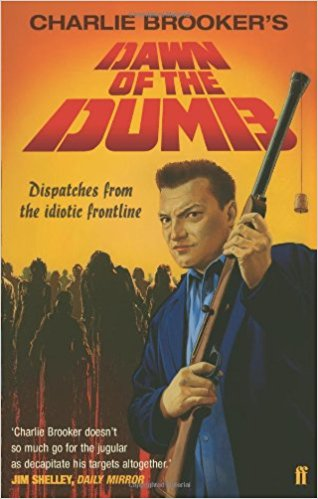
For those of you who aren’t familiar, Charlie Brooker is a British writer, satirist (tough job these days), and broadcaster. He dislikes most things and swears a lot. The nun I have in mind is Pema Chodron, an American Buddhist teacher and author.

How did I arrive at this improbable conclusion that these unlike people are very much alike? It started with binge-reading Pema Chodron. Sometimes books, like people, appear in your life and you wonder how you lived without them. They bring a fundamental shift of energy and wisdom that kicks down a door in your brain, shines light into a black room and blows away the dust.

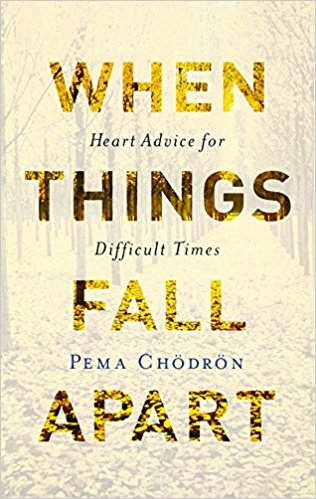
One of Chodron’s books cropped up on the shelf of an Airbnb in rural Arkansas. Stealing it seemed like bad karma, so I went to Amazon for When Things Fall Apart and The Wisdom of No Escape. I was reading the latter on a flight to London, trying to jog myself out of a weird funk. The world felt like it was shrinking around me. Telltale clumsiness had emerged: dropping things, taking wrong turns, sending idiotic emails, all the usual signs of a swerve into depression. I needed to hear something good.

Chodron writes things like:

Our wisdom is all mixed up with what we call our neurosis. Our brilliance, our juiciness, our spiciness, is all mixed up with our craziness and our confusion, and therefore it doesn’t do any good to try to get rid of our so-called negative aspects, because in that process we also get rid of our basic wonderfulness.

Don’t you feel better, saner, more worthy, just reading that?

How about:

Loving-kindness — maitri — towards ourselves doesn’t mean getting rid of anything. Maitri means that we can still be crazy after all these years. We can still be angry after all these years. We can still be timid or jealous or full of feelings of unworthiness. The point is not to try to change ourselves. Mediation practice isn’t about trying to throw ourselves away and become something better. It’s about befriending who we are already.

That’s how she thinks, speaks, writes. Chodron exudes calm. Her philosophy is that people are basically good and need only to wake up that inner goodness.

Charlie Brooker begs to differ. “I don’t get people,” he writes. “What’s their appeal, precisely? They waddle around with their haircuts on, cluttering the pavement like gormless, farting skittles. They’re awful.”

That’s from Dawn of the Dumb, a collection of his “Screen Burn” columns for the Guardian from October 2004 to June 2007. The dates are significant because that was the pinnacle of my London music journalist/gadabout phase. It spanned my final year at Q, another year on a now defunct music magazine, and a stint as a promotions coordinator for a megalomaniac.

Good years, spent in a delicious, mindless haze of 9-to-5, city breaks, cohabiting, cult TV, and the Saturday Guardian: a newspaper that was the lynch-pin of a way of life, shorthand for everything that was important at the time: London, media, “culture”, aspirational cooking, self-conscious irony.

We didn’t watch loads of TV, but what we did was almost exactly what Charlie Brooker was writing about in “Screen Burn” (with the exception of The Apprentice, which I could never stomach). It wasn’t a matter of seeking out the shows he reviewed, more that he unerringly targeted the excruciating and gawp-worthy. Which we happened to watch for those precise reasons.

Finding Dawn of the Dumb amidst the pile of discarded holiday reads in the foyer of our building was like discovering a time capsule from that slice of my life. It took me back to an innocent time when the prospect of David Cameron as prime minister was just a horrible fantasy, and Big Brother still launched careers (if you can call them that). To my surprise, I still remember most of the BB contestants he skewers, a decade later, not to mention various X-Factor one-hit wonders.

Brooker makes it worth revisiting. He can make almost anything funnier and more vivid than real life. Take his description of Glastonbury music festival:

Once you’re in, the sheer scale of it is initially overwhelming. Imagine forcing the cast of Emmerdale to hurriedly construct Las Vegas at gunpoint in the rain. Then do it again. And once more for luck. That’s Glastonbury: a cross between a medieval refugee camp and a recently detonated circus.

As a veteran Glasto-goer, I promise that is the best description of it you will ever read.

I also watched the pilot of Prison Break, which he summarises thus:

Prison Break is possibly the dumbest story ever told. It makes 24 look like cinéma vérité. It’s as realistic as a cotton-wool tiger riding a tractor through a teardrop. I’ve played abstract Japanese platform games with more convincing storylines.

Brooker writes like a butcher dismembering a cow and most of the time his (metaphorical) knife is hacking at a hapless reality show contestant or D-list presenter. Not, you might think, of a piece with Chodron’s all-embracing gentleness.

Yet through them both runs a thread of intense compassion. Brooker’s rage isn’t at individuals, per se, it’s at the cruelty, greed or stupidity they manifest on TV. His purest vitriol is aimed at psychics that prey on the “grieving and desperate”. No matter how artfully furious, his columns boil down to one message repeated over and over: The world’s a mess, people are a mess, we need to be better and nicer to each other if we’re going to get through.

Charlie Brooker may disagree with this characterisation of his intent, but read the books: it’s there. Like Pema Chodron, he believes people can be better if they just wake up. His method is bucket of ice over the head accompanied by a swift kick to the kidneys versus her cultivate mindfulness and be friendly to yourself but they point the same direction.

This proves Chodron’s point about brilliance/craziness. There is no single right way to do things. You can sit in meditation and learn to love each out-breath. You can also sit, shrieking, in front of crap TV. It’s not just what you do — it is the intent and spirit in which it is done.

The corollary to that is you can learn from all sorts of things. Laughing till I cried over Dawn of the Dumb was as mind-altering as mulling The Wisdom of No Escape. Don’t shut things down, they both counsel. Keep your eyes and mind wide open, and try to laugh.

What is a culture-clash that inspired you? Share in the comments!

On Hyperlexia

Photo by Josh Applegate on Unsplash

Among the notable words I learned in 2022 was hyperlexia. Burrowing into articles about autism, the term popped up. Hyper = excessive, lexia = related to words. That rung a bell, personally and professionally.

Defining hyperlexia

In 1997, Aram described hyperlexia as, “the developmental disorder in which children decode words early but have significant impairments in aural and reading comprehension”.

Nation (1999) defined it as, “advanced word-recognition skills in individuals who otherwise have pronounced cognitive, social, and linguistic handicaps.”

Four years later, a meta-study by Grigorenko, Klin and Volkmar (2003) concluded “that hyperlexia is a superability demonstrated by a very specific group of individuals with developmental disorders.”

A few years further along, the definition had grown more nuanced: Ostrolenk et al. (2017) wrote that it is, “the co-occurrence of advanced reading skills relative to comprehension skills or general intelligence, the early acquisition of reading skills without explicit teaching, and a strong orientation toward written material, generally in the context of a neurodevelopmental disorder.”

The final clause of that last sentence is significant to the discussion/debate around hyperlexia, which has been running since the mid-20th century. Is it a disability or, as Grigorenko et al. argue, a ‘superability’?

Hyperlexia and developmental disabilities

The answer starts with statistics. Ostrolenk et al. (2017) found that 84% of hyperlexic subjects were autistic.

This does not mean there is a direct correlation between autism spectrum disorder (ASD) and hyperlexia. In a 2021 study by Solazzo et al., “9% children with ASD showed early hyperlexic traits”.

So, while autistic individuals are not necessarily hyperlexic, there is a good chance that hyperlexic individuals are autistic.

This makes hyperlexia a significant issue for teachers, especially those who teach gifted students. Arguably, especially those who teach gifted girls.

Risks of hyperlexia

In Aspergirls (2010), Rudy Simone writes, “this early ability to read and comprehend above our years (hyperlexia) gives some young Aspergirls an air of intellectual maturity that tricks people into thinking we possess emotional maturity as well. It also hides autism by shielding our deficits.”

Conventional education is built on a foundation of reading and writing. This fundamental bent of our educational system privileges students who appear to read effortlessly and above-grade-level.

As a teacher, it is natural enough to be wowed when a student sets down their book 10 minutes into an assigned reading period and says: “I’m done. What do I do now?”

Since we associate literary skills with intelligence and competence, it is tempting to stereotype precocious readers as super-competent or super-smart.

It takes discipline to stop and ask ourselves: “What is this student really absorbing? What needs might this apparent super-competence be masking?”

Knowing that north of 80% of hyperlexic kids are on the autism spectrum, we need to treat hyperlexia as seriously as we would treat dyslexia. Otherwise, we risk overlooking significant intellectual, developmental and social-emotional needs.

What hyperlexia is not

  1. Key to academic success
  2. Proof a student has it all figured out
  3. Sign of high executive function
  4. Substitute for social and emotional skills

Let’s look at these one by one

Academic success

According to Zhang and Malatesha Joshi (2019), “originally the term ‘hyperlexia’ only referred to those readers with low IQ but precocious decoding skills”. Though, as we’ve seen, the definition has become more nuanced with time and research, the significant fact of hyperlexia is that it is out of sync with the child’s other capacities.

Whipping through a textbook chapter or an assigned story is an accomplishment, but it doesn’t mean the student is equally precocious in other areas. Hyperlexia should be treated as a sign that a student potentially needs more, not less, general academic support.

Proof a student has it all figured out

Rapid reading does not mean improved comprehension. In 2010, Castles et al. published research that found “clear evidence of a dissociation between reading accuracy and comprehension of the same set of irregular words in hyperlexia.”

In the classroom, I’ve witnessed students who read with astonishing speed and fluency but struggle to offer a simple summary of what they’ve just read. Their decoding is phenomenal, but they are not grasping the significance of the words they skim so easily.

It is vital that teachers do explicit work on comprehension (including explicit and implicit details, descriptions, inference, word choice, etc.) with hyperlexic students, not assume, they read it = they got it.

Sign of high executive function

Author Cynthia Kim was diagnosed with Asperger’s (now formally included under ASD) in her early 40s. In her 2014 book, Nerdy, Shy, and Socially Inappropriate, she reflects on her schooldays:

“Doubly-exceptional children have an advantage in their intelligence.

Unfortunately, part of this advantage is that we can mask a big portion of our disability with coping strategies and adaptations. And when we fail to hide something, people assume we’re not trying hard enough. Or we’re being deliberately obstinate. Or that we’re lazy, defiant, insolent, shy, ditzy, or scatterbrained.

‘What’s wrong with you?’ they ask incredulously. ‘You can memorize the batting averages of the entire Major League, but you can’t remember to put your homework in your backpack?'”

Research shows up to 80% of people with autism have executive function difficulties. Again, as educators, we need to avoid the category error of assuming that a hyperlexic student will be as quick in other aspects of their life and studies. Rather, we should be alert to the fact it’s likely the opposite: hyperlexia means greater likelihood of executive function challenges.

Substitute for social and emotional skills

Being able to read texts about sophisticated social and emotional realities does not equal understanding or being able to navigate those realities.

“Difficulty with communication and interaction with other people” is a core diagnostic criterion for autism (Diagnostic and Statistical Manual of Mental Disorders, cited by the National Institute of Mental Health).

Precocious reading is more likely to be a refuge than an aid to an autistic child. Books are safe, comforting and non-judgmental. They have predictable narrative arcs. They are readily available and don’t demand emotional reciprocity.

Photo by Adam Winger on Unsplash

Books are marvellous, natch, but as teachers we have a responsibility to support students’ holistic development. That means supporting social and emotional skills through appropriate collaborative or group activities, encouraging them in discussions, and not singling them out for their hyperlexia.

Ideally, we help our hyperlexic students leverage this strength to support weaker areas without making too much or too little of it.

Every student has unique capacities. We need to be aware of the blind spots in our educational system, and ourselves, to ensure these develop in full, and avoid privileging specific (dis/super)abilities that fit our narrow definitions of what is useful or laudable.

What is your experience with hyperlexic students? Questions? Comments?

Journalism’s Role in Teaching Critical Thinking

This week I’m going to share a podcast recorded last summer (on one very HOT afternoon) for Le Sallay Academy. It features a conversation between myself and the wise, incisive author/journalist/memoirist Kat Lister.

It is shared with the kind permission of Le Sallay, which facilitated and hosted the podcast as part of its Le Sallay Talks series.

Reach Kat Lister on LinkedIn or via Blake Friedmann Literary Agency

***

Here are some highlights from the conversation:

Kat Lister on navigating the media of today

It’s very hard even for those working in the industry to navigate such a fast-changing landscape, and I don’t think there is any one person who is doing it perfectly. And the way that we learn and grow, and familiarize ourselves is by having conversations like this, which have to be very open about the downfalls of social media, but also about what the positives are, and what we can gain from it.

It’s not going anywhere. None of these platforms is going anywhere. The only thing that can change is our relationship with it and that can seem quite chaotic nowadays: it can be a hard place to navigate, it can be a hard place to verify. What is news? What is fake news?

The best way to make our way through this is to think about the original source. You see a video shared a gazillion times on Twitter, and that almost immediately verifies it in your mind, but actually, that’s not the asset to look at. I often have to double-check myself, because I will be almost hitting retweet, and then I’ll be like, hang on a second, where was the video filmed, who filmed it, where was it filmed, are the details correct? Is the date right?
Contextualizing tweets or videos on TikTok or wherever you happen to find yourself, is tremendously important. We’ve all become fact-checkers in a way, and that’s an incredible responsibility not only on the content creators but also the responsibility of the readers, on the audience. As we are saying, look at things more critically, and now, more than ever that’s become quite urgent. And it’s not something any of us are doing in a perfect way, I don’t think.

Cila Warncke on teaching

Yes, these are the traditional 5 W-s: When, Where, When, Who, and Why. And this is something that as a Literature teacher I really emphasize, continually asking students: “Okay, what’s the context of this? Whether it’s an article or a short story, make sure you understand where this is coming from. There is a direct relationship between that kind of critical reading of anything and the ability to navigate the news.”

Click here to listen to the full podcast

On Reading Like a Writer

This is an article I wrote several years ago, based on interviews with three brilliant, inspiring writers. It is worth revisiting.

_____________________________________________

boat

“It is impossible to become a writer without reading,” says Paul Hendrickson, writing professor at the University of Pennsylvania and award-winning author of numerous books including Hemingway’s Boat.

novel

There is a relationship between quality of reading and quality of writing. And a distinction between reading for pleasure and reading like a writer. The difference involves attitude, approach and appreciation. Michael Schmidt, poet, professor and author of The Novel: A Biography recommends reading, “with eyes wide open, full of anticipation.”

With this in mind, here are seven ways to read like a writer:

1. Compulsively

“You can’t be a writer unless you have a hunger for print,” says Nick Lezard, Guardian literary critic and author of Bitter Experience Has Taught Me. “I was the kid who sat at the table and read the side of the cereal packet.” In Nick’s case, the lust for literature paved the way for a career as a book reviewer. But regardless of the genre or field to which you aspire, all writers are readers first.  And “it doesn’t matter whether the medium is the side of the cereal packet or a screen,” Nick says.

bitter

2. Slowly

Cereal-packet readers tend to wolf words like they do breakfast. This is a trait writers should train themselves out of – at least sometimes. Paul defines reading like a writer as slow reading: dawdling on the page, delving, soaking in the style and rhythm. Don’t read everything this way, though. “I don’t read the newspaper ‘like a writer’,” he notes. “I don’t have time. Nobody does.”

3. Broadly

farewell-arms

Time is of the essence for the reading writer, but that doesn’t mean you should ignore everything apart from the classics. There are, to borrow Orwell’s term, good bad books. Nick mentions Ian Fleming as an example of compelling though less-than-literary fiction. Paul gives a nod to Raymond Chandler, saying writers can learn from his “hardboiled, imagistic lines.”

4. Selectively

That said, don’t make the mistake of reading widely but not too well. “Reading crap is no good for the eye or ear,” says Michael. “Read only the best, and read it attentively. See how it relates to the world it depicts, or grows out of.”

Nick, who has read his share of bad books as a reviewer, concurs: “If you just read books like 50 Shades of Grey or Dan Brown, you’re going to wind up spewing out a string of miserable clichés.”

 5. Attentively

stein

You get the most out of good writing by reading it with real attention. Michael advises writers to pay heed to metaphor, characters’ voices, how the author develops those voices and how they change. He recommends Christina Stead’s The Man Who Loved Children as a rewarding subject of attentive reading: “There is a strong sense of development, nothing static there. I can think of no better pattern book for a would-be writer.”    

6. Fearlessly

ulysses

Reading like a writer means going out of your comfort zone. When Nick was in his teens he tackled James Joyce’s Ulysses. “It was a struggle,” he recalls. “It took me a year or two. But that’s how you [learn] – you find stuff that’s above your level.”

7. Imaginatively

Reading above your level is valuable, in part, because it challenges your imagination. Paul talks about savoring the terse beauty of poetry and imagining “everything that’s between the spaces of the words, the spaces of the lines.” By observing the work of your own imagination you gain insight into how writers evoke images and emotions.

You don’t have to read every book (or cereal box) like a writer. But the more you immerse yourself in words and cultivate these seven skills, the better your writing will be. “If you are writing a potboiler, imagine how wonderful it will be if the work you produce is actually a proper novel,” says Michael. “Read the best, and read the best in your elected genre.”

lighthouse

Writers’ Recommended Reading:

Ulysses – James Joyce
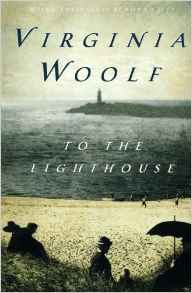
To The Lighthouse –Virginia Woolf
A Farewell to Arms – Ernest Hemingway 
Three Lives – Gertrude Stein
New York Review of Books

On Reading Aloud to Older Students

Reading aloud is like breast feeding: everyone agrees it is vital for the very young, but past a certain age it gets side-eye.

There is ample research on how reading aloud supports early literacy (Wiseman, 2010; Lennox, 2013, etc.).

What about reading to older students though?

Should story-time, like nursing, be confined to the earliest stages of life, or should it continue beyond the point kids can autonomously digest texts?

Photo by Annie Spratt on Unsplash

If primary function of reading aloud is to support literacy, research shows that reading to older learners “boosts their reading comprehension, increases their vocabularies, and helps them become better writers. In fact, students who are read to are more motivated to read themselves” (Blessing, 2005).

Zehr (2010) reported that, “teachers found by trial and error that reading aloud worked for adding interesting content or making literature come alive for students. And some educators say they read to their classes to model good reading, such as by asking comprehension questions as they go along.”

It is always gratifying when research supports my predilections, but I’ve been reading to older students — including adult learners — for as long as I’ve been teaching. Partly, it’s a failure of imagination: I loved being read to, cannot imagine anyone disliking it.

To be clear: my childhood pleasure in hearing books aloud had nothing to do with lack of independent reading skills. I could read by age four and would compete with myself to see how many pages I could read in a day. My record was 1,000. It was a 1,000 pages of the Paddington Bear series — not War and Peace — but the point is I read like a my life depended on it.

The pleasure of being read to was something else. Books I could (and did) read myself were still a joy to hear being read by my older sister, or one of my parents. We also tuned in to read-aloud radio programs, memorably The Hitchhiker’s Guide to the Galaxy and Jeeves and Wooster.

***

What makes reading aloud so marvelous? And why should it be part of every literature and language teacher’s repertoire?

To get another perspective, I interviewed Andie Yellott, a lifetime English teacher, former Johns Hopkins Center for Talented Youth Writing Program supervisor and parent of a child with dyslexia.

  1. Should reading aloud be continued beyond reading competence?
    Yes. Absolutely. When my son was in fourth grade, I would go in for one hour during lunchtime and read to his class. It was the highlight of the week, they told me. They loved it. They always wanted one more chapter.
  2. How did reading aloud support your son with dyslexia?
    He could not have gotten through school without me reading to him. I read everything, even the godawful high school health book. One of the advantages to reading aloud is you can stop and springboard off into other paths, other conversations, which you wouldn’t do if the kid was reading alone. And if you want a kid to do well on a standardized test, read, read, read.
  3. How did reading to your dyslexic son facilitate his communicative abilities?
    He’s got a huge vocabulary. I’d read to him, stop, ask what a word meant, try to figure it out contextually. Reading aloud to him made a difference. He thought he couldn’t write; now, he’s one of the best writers I know.

Like Yellott, I’ve had lots of student enthusiasm for reading aloud. It is more than just fun, though. Reading aloud supports specific skills, depending on whether the teacher or learner is reading aloud. Here are six benefits observed in my classrooms.

Photo by Photo by Tom Hermans on Unsplash

Teacher-led Reading

Improve pronunciation

Native and non-native speakers alike struggle with the whimsy of English pronunciation. In extreme cases, this can lead to students understanding spoken words but not being able to identify them in print, or vice versa. Reading aloud while students follow along in a text is a straightforward way to ensure that kids are matching the right groupings of letters to the sounds they hear. This is especially important for those who struggle with reading and/or are learning English as an additional language.

Build vocabulary

When students are reading independently it is difficult to gauge how well they comprehend individual words. Students may grasp the main idea of a text but miss important vocabulary. As Yellott said, reading aloud is an opportunity to identify and define unfamiliar words in context. While reading to my students, I pause frequently to check comprehension. If they don’t know a word, we search for context clues, then look up the definition to verify our deduction. This is also a great opportunity to reinforce knowledge of parts of speech, e.g. ‘this is the noun fly; what does it mean when we use it as a verb?’

Create community

Reading is too often solitary and functional, the vegetable kids have to eat before dessert. We need to remember: independently reading printed texts is a novelty. For most of homo sapiens‘ time on the planet, stories were oral. People gathered around fires, or beneath fearfully and wonderfully made cathedral ceilings, to listen to a bard/priest/storyteller. Being read to was the only way most people could experience books until the advent of mass public education, which wasn’t all that long ago.

Reading aloud in the classroom reclaims the power of the story to articulate fears, hopes and desires; to delve and reveal. Students who have a chance to respond verbally to a book: express how they feel, ask clarification questions and debate it with their peers, are axiomatically more engaged than those who skim it in lonely silence.

Learner-led Reading

Correct decoding errors

Even competent readers often make decoding errors such as ‘stared’ for ‘started’. If a student is reading silently, there is no chance to identify and correct these slips that, as they accumulate, affect comprehension. Younger and/or less able readers are more likely to make these mistakes, so reading aloud is an ideal tool to support their literacy.

Understand punctuation

If Emily Dickenson was right and “a word is dead./When it is said” then spare a thought for punctuation. Students can learn the function of commas, colons, etc. through direct instruction but that doesn’t automatically translate to competent — much less creative — usage in their writing. One of the best (only?) ways to understand the delicious possibilities of punctuation is to read aloud. By treating the punctuation as a kind of score — lift the voice here, pause, slow down, shout! — students develop the ear for punctuation that every good writer must have.

Improve verbal fluency and confidence

We tend to think of fluency in the context of learning an additional language, but it isn’t just language learners who need to practice this skill. Learning difficulties, lack of a richly verbal home life and shyness are a few of the reasons native speakers may struggle to express themselves fluently in their language. For students who struggle to articulate, whether because they are acquiring the language or for some other reason, reading aloud takes the pressure off of deciding what to say, and allows them to focus on how to say. Reading well-written texts gives students a chance to see how successful communication sounds; they can practice pronunciation, enunciation and tone without the risk of error. Ideally, they can inhabit the voice of the text and, in bringing it to life, experience the possibilities of their own voice.

Parting thought

In Sense and Sensibility the ‘sensible’ (i.e. sensitive) sister Marianne falls in love with Willoughby in part because “he read with all the sensibility and spirit” his rival lacked. In Jane Austen’s time, to read aloud well and fluently was a mark of refinement and good taste. As our world becomes more digitized, text-driven and fragmented, reading aloud is due a renaissance. Anyone can jab out a text; to read a book with eloquence and feeling, though? That’s magic.

How do you feel about reading aloud to older students? What benefits/challenges have you observed? Share in the comments or Tweet @CilaWarncke

18 – Reading Like a Writer

This was another Ideas Tap feature that was mostly an excuse to interview a handful of my favorite people — dear friend and mentor Paul Hendrickson, another beloved writing friend Nick Lezard, and the man who saved my life during my writing Master’s, course director and prolific author Michael Schmidt.

Photo by Eliott Reyna on Unsplash

Want to be a writer? The best way to start is by reading. But how can you make sure you reap the benefits in your own work? Cila Warncke asks writers Paul Hendrickson, Nick Lezard and Michael Schmidt for tips…

“It is impossible to become a writer without reading,” says Paul Hendrickson, writing professor at the University of Pennsylvania and award-winning author of numerous books including, most recently, Hemingway’s Boat.

There is a relationship between quality of reading and quality of writing. And a distinction between reading for pleasure and reading like a writer. The difference involves attitude, approach and appreciation. Michael Schmidt, poet, professor and author of the forthcoming The Novel: A Biography recommends reading, “with eyes wide open, full of anticipation.”

With this in mind, here are seven ways to read like a writer:

1. Compulsively

“You can’t be a writer unless you have a hunger for print,” says Nick Lezard, Guardian literary critic and author of Bitter Experience Has Taught Me. “I was the kid who sat at the table and read the side of the cereal packet.” In Nick’s case, the lust for literature paved the way for a career as a book reviewer. But regardless of the genre or field to which you aspire, all writers are readers first.  And “it doesn’t matter whether the medium is the side of the cereal packet or a screen,” Nick says.

2. Slowly

Cereal-packet readers tend to wolf words like they do breakfast. This is a trait writers should train themselves out of – at least sometimes. Paul defines reading like a writer as slowreading: dawdling on the page, delving, soaking in the style and rhythm. Don’t read everything this way, though. “I don’t read the newspaper ‘like a writer’,” he notes. “I don’t have time. Nobody does.”

3. Broadly

Time is of the essence for the reading writer, but that doesn’t mean you should ignore everything apart from the classics. There are, to borrow Orwell’s term, good bad books. Nick mentions Ian Fleming as an example of compelling though less-than-literary fiction. Paul gives a nod to Raymond Chandler, saying writers can learn from his “hardboiled, imagistic lines.”

4. Selectively

That said, don’t make the mistake of reading widely but not too well. “Reading crap is no good for the eye or ear,” says Michael. “Read only the best, and read it attentively. See how it relates to the world it depicts, or grows out of.”

Nick, who has read his share of bad books as a reviewer, concurs: “If you just read books like 50 Shades of Grey, or Dan Brown, you’re going to wind up spewing out a string of miserable clichés.”

5. Attentively

You get the most out of good writing by reading it with real attention. Michael advises writers to pay heed to metaphor, characters’ voices, how the author develops those voices and how they change. He recommends Christina Stead’s The Man Who Loved Children,” as a rewarding subject of attentive reading: “There is a strong sense of development, nothing static there. I can think of no better pattern book for a would-be writer.”    

6. Fearlessly

Reading like a writer means going out of your comfort zone. When Nick was in his teens he tackled James Joyce’s Ulysses. “It was a struggle,” he recalls. “It took me a year or two. But that’s how you [learn] – you find stuff that’s above your level.”

7. Imaginatively

Reading above your level is valuable, in part, because it challenges your imagination. Paul talks about savouring the terse beauty of poetry and imagining “everything that’s between the spaces of the words, the spaces of the lines.” By observing the work of your own imagination you gain insight into how writers evoke images and emotions.

You don’t have to read every book (or cereal box) like a writer. But the more you immerse yourself in words and cultivate these seven skills, the better your writing will be. “If you are writing a potboiler, imagine how wonderful it will be if the work you produce is actually a proper novel,” says Michael. “Read the best, and read the best in your elected genre.”

In Focus: Writers’ Recommended Reading:

  • UlyssesJames Joyce
  • To The LighthouseVirginia Woolf
  • A Farewell to Arms – Ernest Hemingway 
  • Three Lives – Gertrude Stein
  • New York Review of Books