One of the things that has been (is) vital to my success as a writer and educator is the fact that, from a freakishly young age, I’ve read everything.
Nutritional information. Ancient magazines in waiting rooms. Bumper stickers. Barbara Tuchman. The Lord of the Rings. Gossip magazines. Feminist blogs. Not-so-feminist blogs. James Baldwin. Germaine Greer. Cormac McCarthy. Joan Didion (again and again and again). Orwell. Eliot. Hardy. All the Brontes. Shakespeare. Jack Gilbert. The Bible. The Odyssey. Ulysses. Greek myths. Native American myths. Books on veganism, endurance running, Arctic exploration, gardening, history, booze, the Spanish civil war.
The more I read, the more visible the threads that twitch through the living fabric of literature: allusion, image, theme; the homage, the salute, the nod, the whisper from dead to living to the spirits.
Reading like a starving person at a buffet cultivates a literary meta-perception I cannot imagine arriving at any other way. It leads along skewed yet sound philosophical paths, such as the one that follows.
***
Q: What’s the difference between Charlie Brooker and a Buddhist nun?
A: Not much, it turns out.
For those of you who aren’t familiar, Charlie Brooker is a British writer, satirist (tough job these days), and broadcaster. He dislikes most things and swears a lot. The nun I have in mind is Pema Chodron, an American Buddhist teacher and author.
How did I arrive at this improbable conclusion that these unlike people are very much alike? It started with binge-reading Pema Chodron. Sometimes books, like people, appear in your life and you wonder how you lived without them. They bring a fundamental shift of energy and wisdom that kicks down a door in your brain, shines light into a black room and blows away the dust.
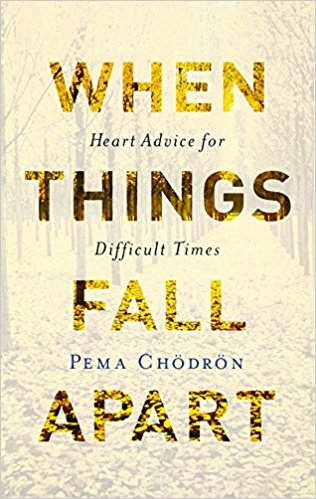
One of Chodron’s books cropped up on the shelf of an Airbnb in rural Arkansas. Stealing it seemed like bad karma, so I went to Amazon for When Things Fall Apart and The Wisdom of No Escape. I was reading the latter on a flight to London, trying to jog myself out of a weird funk. The world felt like it was shrinking around me. Telltale clumsiness had emerged: dropping things, taking wrong turns, sending idiotic emails, all the usual signs of a swerve into depression. I needed to hear something good.
Chodron writes things like:
Our wisdom is all mixed up with what we call our neurosis. Our brilliance, our juiciness, our spiciness, is all mixed up with our craziness and our confusion, and therefore it doesn’t do any good to try to get rid of our so-called negative aspects, because in that process we also get rid of our basic wonderfulness.
Don’t you feel better, saner, more worthy, just reading that?
How about:
Loving-kindness — maitri — towards ourselves doesn’t mean getting rid of anything. Maitri means that we can still be crazy after all these years. We can still be angry after all these years. We can still be timid or jealous or full of feelings of unworthiness. The point is not to try to change ourselves. Mediation practice isn’t about trying to throw ourselves away and become something better. It’s about befriending who we are already.
That’s how she thinks, speaks, writes. Chodron exudes calm. Her philosophy is that people are basically good and need only to wake up that inner goodness.
Charlie Brooker begs to differ. “I don’t get people,” he writes. “What’s their appeal, precisely? They waddle around with their haircuts on, cluttering the pavement like gormless, farting skittles. They’re awful.”
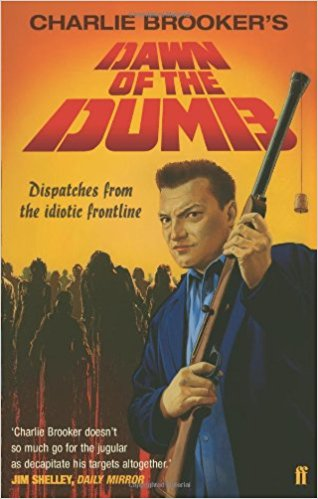
That’s from Dawn of the Dumb, a collection of his “Screen Burn” columns for the Guardian from October 2004 to June 2007. The dates are significant because that was the pinnacle of my London music journalist/gadabout phase. It spanned my final year at Q, another year on a now defunct music magazine, and a stint as a promotions coordinator for a megalomaniac.
Good years, spent in a delicious, mindless haze of 9-to-5, city breaks, cohabiting, cult TV, and the Saturday Guardian: a newspaper that was the lynch-pin of a way of life, shorthand for everything that was important at the time: London, media, “culture”, aspirational cooking, self-conscious irony.
We didn’t watch loads of TV, but what we did was almost exactly what Charlie Brooker was writing about in “Screen Burn” (with the exception of The Apprentice, which I could never stomach). It wasn’t a matter of seeking out the shows he reviewed, more that he unerringly targeted the excruciating and gawp-worthy. Which we happened to watch for those precise reasons.
Finding Dawn of the Dumb amidst the pile of discarded holiday reads in the foyer of our building was like discovering a time capsule from that slice of my life. It took me back to an innocent time when the prospect of David Cameron as prime minister was just a horrible fantasy, and Big Brother still launched careers (if you can call them that). To my surprise, I still remember most of the BB contestants he skewers, a decade later, not to mention various X-Factor one-hit wonders.
Brooker makes it worth revisiting. He can make almost anything funnier and more vivid than real life. Take his description of Glastonbury music festival:
Once you’re in, the sheer scale of it is initially overwhelming. Imagine forcing the cast of Emmerdale to hurriedly construct Las Vegas at gunpoint in the rain. Then do it again. And once more for luck. That’s Glastonbury: a cross between a medieval refugee camp and a recently detonated circus.
As a veteran Glasto-goer, I promise that is the best description of it you will ever read.
I also watched the pilot of Prison Break, which he summarises thus:
Prison Break is possibly the dumbest story ever told. It makes 24 look like cinéma vérité. It’s as realistic as a cotton-wool tiger riding a tractor through a teardrop. I’ve played abstract Japanese platform games with more convincing storylines.
Brooker writes like a butcher dismembering a cow and most of the time his (metaphorical) knife is hacking at a hapless reality show contestant or D-list presenter. Not, you might think, of a piece with Chodron’s all-embracing gentleness.
Yet through them both runs a thread of intense compassion. Brooker’s rage isn’t at individuals, per se, it’s at the cruelty, greed or stupidity they manifest on TV. His purest vitriol is aimed at psychics that prey on the “grieving and desperate”. No matter how artfully furious, his columns boil down to one message repeated over and over: The world’s a mess, people are a mess, we need to be better and nicer to each other if we’re going to get through.
Charlie Brooker may disagree with this characterisation of his intent, but read the books: it’s there. Like Pema Chodron, he believes people can be better if they just wake up. His method is bucket of ice over the head accompanied by a swift kick to the kidneys versus her cultivate mindfulness and be friendly to yourself but they point the same direction.
This proves Chodron’s point about brilliance/craziness. There is no single right way to do things. You can sit in meditation and learn to love each out-breath. You can also sit, shrieking, in front of crap TV. It’s not just what you do — it is the intent and spirit in which it is done.
The corollary to that is you can learn from all sorts of things. Laughing till I cried over Dawn of the Dumb was as mind-altering as mulling The Wisdom of No Escape. Don’t shut things down, they both counsel. Keep your eyes and mind wide open, and try to laugh.
What is a culture-clash that inspired you? Share in the comments!




 Cila Warncke Writer