7 Fun Play-Anywhere Writing Games

Grab a pen and paper and hone your word skills through play!
Photo by Calum MacAulay on Unsplash

Native English speakers only need to learn around 9,000 words to read proficiently (Nation, 2014; Qian & Lin, 2019). This, out of a lexis of over 170,00 words (and growing!)

Hence most of us walk, eat and talk on a daily basis rather than shuffle, feast or murmur.

We’re creatures of habit. The words we use frequently become top-of-mind, and therefore likely to be used again. Our routine vocabulary shrinks like a puddle in the sun.

One way to prevent, indeed, reverse, this trend is to play with words.

Reading, crossword puzzling, etc., can build our word banks but having a fine working vocabulary means being able to summon novel words and express ourselves in new ways. Like play piano, or basketball, this skill requires practice.

The following drills are designed to be pen-and-paper; no reference to outside sources required. Use the back of an envelope, a napkin, scribble on your hand like a teenager, draw in sand on the shoreline.

The goal is to tap your linguistic aquafer. If you feel inspired to augment your vocabulary through reading or dictionary browsing, all to the good, but no pressure.

Grab your quill and parchment and let’s away.

_________________________________________________________________________________

Pre-root-ixes: Prefixes, root words and suffixes

Straightforward: choose a prefix, root word or suffix and list as many words containing it as you can.

  • Prefix suggestions: ex, dis, im, dis, pre, un
  • Root suggestions: auto, corp, derm, lum, tele
  • Suffix suggestions: ism, ity, ment, ness, tion/sion

Word transformation

This is a game I designed to improve upper-level ESL students awareness of parts of speech (POS) and the flexibility of English vocabulary. It’s simple, take a noun or verb, then come up with all the permutations of it you can, including words that contain it, collocations or sayings.

It works best when you think systematically about POS. Let’s use like as an example.

  • Verbs: to like, to dislike
  • Nouns: like, likelihood, liking, dislike
  • Adjectives: like, likeable, likely
  • Adverbs: like, likely, unlikely
  • Preposition: like
  • Conjunction: like
  • Collocations/sayings: eat like a horse, go over like a lead balloon, off like a shot, like water off a ducks back, look like a million dollars, etc.

Photo by Hannah Olinger on Unsplash

CAS – colloquialisms, aphorisms and sayings

Here, the goal is to list informal language terms that either

  • contain a particular word (as in the example above)
  • relate to a particular subject (e.g., work, money, travel)

Take ‘time’ as an example. The first category might include

  • time and tide way for no man
  • a stitch in time saves nine
  • once upon a time
  • time is (not) on their side
  • time out of mind

The second

  • to take a rain check
  • down to the wire
  • from here to eternity
  • jump the gun
  • Rome wasn’t built in a day

Single-word prompts

This drill was the result of being bored of my journal. Left to itself, my squirrelly brain chews over the same topics like its storing fat for winter. So I wrote a random word at the top of each page then, each day, wrote something inspired by it.

Try this for five, seven, 10, 14 days. See what fun your mind has.

Alphabets

Another fast, fun list drill. Jot the alphabet vertically on a sheet of paper then fill it in with words from a given category: adverbs, cities, animals, desserts, compound nouns.

Warm up with a big category like plants or household objects then get esoteric: can you complete the alphabet with shades of blue, pre-20th century literary heroines or 80s song titles?

What do you see?

Prior to writing my novel Ibiza Noir, I wrote 700 words of pure description a day for 30 days. No attempt at narrative, simply drew the most vivid word-pictures possible.

  1. Set a time or word-count goal, e.g., write for 10 minutes without stopping, or write 500 words.
  2. Choose an object of reasonable complexity, a flower, or your living room, and describe it in as much detail as you can muster. Imagine you are describing it to an artist; you want their rendering to be as close to reality as possible.
  3. Challenge yourself to apply this descriptive writing practice to real-world scenes. Go sit in the park, or on a bench at the mall, and write your allotted words. But remember, no narrative, just images.
Photo by Markus Winkler on Unsplash

Daily ledes

This drill is perfect for pre-bedtime journaling.

  1. Choose three events/moments from your day.
  2. Jot down the 5Ws: when, where, who, what and why.
  3. Write a lede (the first sentence or paragraph of a news article) that contains all 5Ws.

Example:

  1. You went to the dentist and got your teeth cleaned.
  2. When: 11:30AM, where: dentist office (43 Main Street), who: hygienist David, what: tooth cleaning, why: six months since last appointment
  3. Lede: At 11:30 this morning, dental hygienist David Smith faced off with a six-month old plaque formation on Patient X’s right rear molar, a struggle that resounded through the office at 43 Main Street.

Bonus game! #semanticfieldgoals

Yes, I just wanted to write #semanticfieldgoals.

It’s also a good game.

A semantic field is a set of words related by meaning, for example colors, plants, foods, senses, etc. For the sake of this drill, any category will do.

Choose a category

  • List all the words you can think of related to that category.
  • Choose one of those words as the starter for a new list.
  • Repeat as often as you like.

Let’s try chemistry:

  1. Chemistry: periodic table, ion, Madam Curie, Nobel Prize, beaker, lab, Bunsen burner, ion, orbital, atom, atomic weight, electron, proton, neutron, bond, reaction, element, carbon, organic
  2. Atom: ancient Greece, Democritus, particle, bomb, Oppenheimer,
  3. Ancient Greece: philosophy, alphabet, city-states, wine, Homer, Sparta, etc.

___________________________________________________________________________________________

Play a round or two of one of the games and post your results in the comments!

On AI: Artificial Ignorance

Artificial intelligence promises to augment our collective processing capacity. But on an individual level it is a neurotoxin that promises learners only artificial ignorance.

We are all familiar with the fact that unused muscles weaken, then atrophy. If one were to permit a developmentally normal, able-bodied child to rely on mobility scooter for transport they would, over time, develop physical incapacity where none had existed: an induced disability.

Photo by lilartsy on Unsplash

Thus, it shouldn’t be difficult to grasp that permitting children to rely on artificial intelligence ‘assistance’ such as ChatGPT will weaken, then atrophy, their intellectual capacity: an induced disability.

Writing a better brain

Writing is not just the product of thought. It has a unique ability to generate thought.

  • ‘I write entirely to find out what I’m thinking’ ~Joan Didion, journalist.
  • ‘With each of the new [ancient] writing systems, with their different and increasingly sophisticated demands, the brain’s circuitry rearranged itself, causing our repertoire of intellectual capacities to grow and change in great, wonderful leaps of thought.‘ ~Maryanne Wolf, Director of the UCLA Center for Dyslexia, Diverse Learners, and Social Justice.

As Wolf explains in her 2007 book Proust and the Squid (from which the above quote is taken) there is neither gene nor discrete neurological structure that enables humans to read and write. Literacy relies on complex, non-axiomatic collaborations between a variety of perceptual and cognitive systems.

Put another way: preliterate and literate brains are structured the same. What changed human history was not a novel biological development but the recruitment of extant neurological capabilities to perform a novel task.

Does that bend your mind a little?

It should.

Writing is not just a means of expression, like speech. It is a process and practice that improves cognitive function; it rewires the brain.

Put another way: it isn’t that smart people are better writers, it’s that writing makes people smarter.

Photo by Santi Vedrí on Unsplash

All of us who care about children’s long-term well-being, whether they are our students or offspring, should be anxious to help them develop their fullest intellectual capacity.

We are on a hot rock spinning towards oblivion. Life for kids who are in today’s classrooms will be complex beyond the wildest imaginings of us scions of the analogue order. The will need to be wily, resilient and resourceful AF.

Being laissez-faire about kids substituting artificial intelligence for study makes as much sense as being laissez-faire about children playing with live hand grenades: cool, if you don’t mind the maiming.

There are three key reasons I won’t use generative AI and emphatically discourage its use by students.

Neural stunting

A well-used brain grows, according to Pauwels et al. (2018):

“Practice leads to improvement in and refinement of performance… and this dynamic behavioral process is associated with altered brain activity…. Besides functional brain changes, practice also induces structural changes, such as alterations in regional brain grey and white matter structures.”

A brain that does not practice complex skills fails to grow, just as the disused muscle slumbers undeveloped. The brain becomes stunted compared to what it could have been, could be, with training.

A less-developed brain with fewer neural connections and reduced processing efficiency does not just affect reading or writing skills. If affects a person’s ability to learn, communicate and adapt.

Every time a student outsources their thinking to AI, they are sabotaging their long-term mental flexibility.

Educators and parents bear responsibility for this, insofar as we perpetuate a results-based learning environment. When we prioritize the ‘right answer’, kids get the message that process doesn’t matter. It makes sense for them to use any means necessary to get the answer that gets the desired grade.

We grown-ups need to rewire our thinking and explicitly focus on the learning process. This is not going to be easy, given the baggage of 150-odd years of rote education, but we have to begin. This might be as simple as grading the steps of an essay instead of the final draft, or doing away with grades altogether in favor of a feedback system. (For more ideas: Ungrading with Anthony Lince)

Photo by Markus Spiske on Unsplash

Concentration of intellectual capital

Late-capitalism has succeeded in concentrating financial capital into the hands of a vanishingly small number of individuals. The grotesqueries of this are felt every time an ordinary US citizen needs insulin or an EpiPen, or wants to go to college. There are felt a thousandfold-moreso by the 650 million people living in extreme poverty around the globe.

This concentration accelerated wildly during the Covid-19 pandemic: ‘Billionaires’ wealth has risen more in the first 24 months of COVID-19 than in 23 years combined,’ Oxfam reported. ‘The total wealth of the world’s billionaires is now equivalent to 13.9 percent of global GDP.’ 

Put another way: those of us not born to oligarchy face ever-slimmer chances of rising to the top. Financially, anyway.

Until now, those not to the manor born could at least, to paraphrase Britpop’s finest cynic, Jarvis Cocker, use the one thing we’ve got more of: our minds.

Unless we allow kids to consign their thinking skills to artificial intelligence.

To be clear, I don’t believe there is a conspiracy among Musk, Zuckerberg, et al. to make the rest of the population dumber so they can rule in full-blown, unchecked Bond-villainesque splendor (mwah haha).

But there is a real danger of that dystopia becoming a reality through lack of vigilance on the part of educators, parents and politicians.

Big tech does not care about us. Does not exist to serve us. Is not our toy.

In the same way wealth-accumulation takes on a life of its own, with money begetting money, intellectual capital accretes to the intellectually adept. Students who read, write and think critically enhance the neural circuits for these skills, gaining efficiency, automaticity and self-confidence.

This enables them to tackle bigger challenges, be more creative, rise to the top. The better they get at learning, the more dauntless they will be; the more quickly they will evolve to meet new demands.

Students who let AI think for them will cultivate artificial ignorance, sap their innate learning abilities and dull themselves into ever-shrinking spirals of incompetence and self-doubt.

They will be victims, not victors, in the knowledge economy.

Diminishing returns

Generative AI is trained on scads of data.

Perhaps one of the reasons it shines is that current tools were trained on the laborious output of human brains. Right now, the machine is well-nourished.

Like any other extractive technology, AI’s potential is limited by the quantity of quality raw material available. As AI is increasingly used to generate blog posts, articles, images, etc., it will, perforce, eat itself. Like a hideous, post-post-modern game of telephone, machine learning will digest its own output to spew forth content that is increasingly bland, distorted and derivative: a garbled self-parody that will further diminish culture and conversation.

This is not an abstract concern. There are AI tools I recommend to students on a limited basis, such as Grammarly, for English-learners or novice writers who need grammatical training wheels. I discourage competent writers from using it because it flattens good writing.

Neither it, nor any AI tool, can distinguish a truly beautiful sentence nor appreciate the work of (to borrow from Salinger) an experienced literary stunt-pilot. Creative word usage, neologisms, daring sentence structures all fall foul; the machine brain cannot cope with linguistic audacity.

This is the chief weakness and biggest threat of artificial intelligence: it prefers the commonplace to the extraordinary and the predictable to the audacious.

Our world needs bold solutions and novel ideas, which it will not get from a conservative technology.

There are plenty of things to outsource to AI: reviewing medical data, tracking undersea tremors, preventing fraud. But not education.

The children whom we want to see thrive need every iota of intellectual capacity and creativity that dedicated teaching and rigorous practice can bestow. Otherwise, we doom them to artificial ignorance.

What are your views on AI in the classroom? Share in the comments?

On Suede (band, not shoes)

Writing is integral to my teaching process and practice. When I publish, it is a privilege to share.

Pennyblackmusic.co.uk runs a regular feature called Discography Hagiography. In which, as the name suggests, music nerds get to publicly worship bands they love.

Imagine my delight when editor John Clarkson gave me the nod to write about Suede on the occasion of the band’s 30th anniversary and mind-bendingly good LP, Autofiction.

Writing this brought me joy. May reading it bring you joy.

(Below, an excerpt. Full article here. Photos are illustrative, not of Suede.)

Photo by Chris Spalton on Unsplash

Suede: Discography Hagiography

In 1998, I walked into a record shop on Philadelphia’s South Street to return a damaged Bush Sixteen Stone CD.

No refunds, the proprietor said, pick something in exchange.

Crouched on the wooden floor, I scanned the bottom shelf. The London Suede rang a bell. I studied the androgynous/ambiguous nude puddled in ghastly underwater green. On the back, the name ‘New Generation’ popped (it was on a mix CD from my brother). Sold.

This was the start of a semi-obsessive love affair, a fact I offer as an excuse for my inability to present a concise career appraisal of Britpop’s most reckless proponents. This will be a true hagiography, with the irrationality and ellipses that veneration of a saint implies.

Suede shook my foundations the same way some people have: not love at first sight, exactly, but recognition – an undefinable, undeniable, life-altering entrance into the presence of one who is known and knows in return.

Brett Anderson was the first person I heard pronounce ‘mascara’ mass-kah-rah; I had no idea what a pebble-dash grave might be nor, for that matter, an estate car. But Suede stirred my emotions and imagination long before any first-hand experience of strobe-lit nightclubs, ecstasy-blown pupils or the grey lassitude of Home Counties Sunday mornings.

It is hard for me to see beyond the moments of delicious chaos to which Suede was the soundtrack to consider its oeuvre. Nevertheless, stepping back so the wheat field emerges from the golden streaks, yields an equal reward. Suede’s motifs are plainer at arm’s length; Brett Anderson’s lyrical fixations and vocal affections more obvious; but they are the beloved particularities of an old friend.

Listening to the albums chronologically, it is striking how well Suede wire walks between internal consistency and rote predictability. The Suedeness rarely drifts into play-by-numbers or self-parody. While contemporaries like Blur and Oasis lean on nostalgia or WWF-style public spats to generate attention, Suede stormed into its 30th anniversary year with the irresistible Autofiction and a tour that had the oft-contrarian music press singing from the same hymn sheet:

  • “Brett Anderson is absolutely mesmerising. You can’t take your eyes off him” (Taylor, The Mancunion).
  • “If this really were an unknown new band with no reputation to trade on… you’d tell your friends they’ll go far” (Lynskey, Guardian).
  • “Perhaps it’s possible to will a transcendent experience into existence, but this Suede concert fulfilled 25 years of dreaming” (Harris, Spectrum Culture).

Suede (Nude) 1993

That Suede managed to live up to the hype preceding its eponymous debut is impressive; as is the fact that the curse of the Mercury Music Prize has yet to catch the band, three decades on.

Suede invited its audience into a claustrophobic, chemical-laced neverland built on the post-Thatcherian ashes of Britain’s social contract. There is no overt politicking; the lyrical bleakness speaks for itself: ‘in your council home/he jumped on your bones’ (‘Animal Nitrate’) to ‘in the car he couldn’t afford/they found his made-up name/on her ankle chain’ (She’s Not Dead’).

Brett Anderson embodied a sleazy-sexy interface of frustration and hedonism, offering a Wildean aestheticisation of ennui, deprivation and dead-ends that is as hypnotic – and apropos – in the 2020s as it was in the early ‘90s. ‘The Drowners’ is an apt term for the generation coming of age to Brexit, Covid and Toryism. As a debut single, ‘The Drowners’ is also an effervescent blast of indie power-pop that, for its four-minute duration, erases everything except what matters: sex and music.

Like Wilde, Anderson intuited that power aligns against truth, beauty and self-expression. Defiance ain’t much, but sometimes it’s all you’ve got. Hence the avant-garde sexual ambiguity, charity shop-chic shrunken white shirts and midriff-baring pleather and gilt pirate hoops framing diamond-cutter cheekbones. Live performances from 1993 (check out ‘My Insatiable One’ from the Casino de Paris; ‘Animal Nitrate’ from Brixton, London) are fresh and daring. (It is hard to imagine that The 1975’s Matty Healy doesn’t owe at least some of his hyper-emotional, dissolute, sexually fluid stage persona to Anderson.)

Track after track, Suede rings true, powered by Bernard Butler’s starry guitar, bassist Mat Osman, drummer Simon Gilbert and keyboardist Neil Codling. From the wistful ‘Breakdown’ (‘if you were the one/would I even notice, now my mind is gone?’) to the menacing glam stomp of ‘Metal Mickey’ – a song that deserves to be danced to in gold DeHavillands if ever one did – it retains a zest and urgency that belies its age.

Dog Man Star (Nude) 1994

This was my gateway Suede album; ‘New Generation’ on repeat, chasing the dopamine rush of its glittering opening riff (cherish those riffs – this was Butler’s last proper album with Suede; nobody did it better). ‘New Generation’ is the highlight of a record that suits melancholic adolescence but, to my adult ears, could do with rigorous editing. Or, perhaps, it would be more accurate (fairer) to say that the range of situations in which Dog Man Star’s emotional tenor feels relevant and urgent has narrowed with age.

The excellent ‘Heroine’ is more than a track, it’s an atmosphere. Anderson’s drug use has been chronicled ad nauseam, so I shan’t bother, but chaos and indulgence cast distorting shadows over tracks like ‘Daddy’s Speeding’, ‘This Hollywood Life’ and ‘Asphalt World’ – the latter a sublime four-minute ballad that meanders for more than nine minutes. (Nick Duerden called the album, ‘the most pompous, overblown British rock record of the decade.)

When restraint is exercised, the results are timeless: the raw snarl of ‘Introducing the Band’, whose Winterland reference introduced me to a seminal moment in punk history; ‘The Wild Ones’, a downbeat beauty that sound-tracked a number of my heartbreaks; and the hauntingly sweet piano lament ‘The 2 of Us’, which makes you want a broken heart, just to enjoy it properly.

Considering it appeared just 18 months after Suede’s debut, Dog Man Star attests to the raw brilliance of a band that was driving with both feet on the accelerator and only the occasional hand on the wheel.

Autofiction (BMG) 2022

The image of a nude with back turned to the viewer is a throwback to Dog Man Star but there are important differences: the lens is closer so the body fills the frame; the lines of muscle and bone are clear and vigorous; instead of awkwardly bent, the arms hug the torso in a gesture of comfort or reassurance. Instead of disaffection and despair, the black-and-white shot evokes vulnerability tempered with strength; containment rather than dissolution.

Suede’s ninth studio album delivers on the implicit promise of its striking cover: intimate, strong, self-contained, vulnerable, bold. Opener and first single ‘She Still Leads Me On’ took a few listens to worm into my neurons; it is now embedded there and generates the same dopaminergic kick as vintage favourites like ‘New Generation’ or ‘Killing of a Flash Boy.’

True to form, the next two tracks keep the intensity at a killing pitch: ‘Personality Disorder’ is a cocky, raucous snarl that pulls off the not-easy feat of wedding spoken-word verses with an arena-sized chorus. Then Anderson snaps into ‘15 Again’ with the whip-crack lyric: ‘Nothing is as bad as the time we kill/ sitting in the bathroom in kitten heels’.

Praise be. The band is back, as and how and when we need it most: dripping sweat, spitting defiance, yielding and pushing, feeling with us how it feels ‘on the black ice with no headlights/ with our hands off the wheel’ (‘Black Ice’).

From the soaring ‘Shadow Self’ to the full-throated stomper ‘That Boy on the Stage’ to the pensive ‘Drive Myself Home’ the album flows between moods and moments with cohesion and conviction. If the first act of adulthood is renouncing childish ways, the second is realising that the kid inside never goes away; maturity is integrating all the aspects of self without apology.

Anderson and co. have done so and created a truly mature album, buoyant with the shimmer and swagger of youth yet sober with the wisdom of years. ‘I’m not the kind of person who never feels uncertain/ so many ways to do what I do wrong’, Anderson muses (‘The Only Way I Can Love You…’) but – however many ways there are to do what he does wrong – he does none of them here. Autofiction is, quite simply, a triumph.

After spending several weeks immersed in Suede, two things remain to say: 1) if Autofiction were the last album, it would be the pièce de résistance of a luminous career; 2) I’m pretty sure it won’t be. And that is good news.

What’s the band that changed your life? Share in the comments!
On Culturally Responsive Teaching

The following presentation on culturally responsive teaching was written for, and delivered at, Le Sallay Academy’s January 2023 conference on blended learning.

The term culturally responsive teaching was coined by Geneva Gay. It entails crafting and delivering curricula that is relevant to students’ lived experiences. The aim is to engage students with material that is “personally meaningful” in order to pique their interest and motivation to learn (Gay, 2002).

My interest in culturally responsive teaching and culturally sustaining pedagogy (which I didn’t have the time to get into in this talk) springs from the cultural homogeneity of my own education. As a high school student and undergraduate I read, mostly, books, stories and poems by white male Europeans.

Students deserve better. They deserve to be introduced to a rich, multicultural world of literary experiences and they deserve to see themselves represented in what they read. As a teacher, its my job to think about students’ intersecting identities: nationality, language, gender, ethnicity, class, faith, etc.

This presentation focuses on language as a form of cultural and self-identity, and the importance of representing multiple Englishes within an English Language Arts curriculum. This was highly relevant because the students in this class hailed from several countries and spoke more than a dozen languages.

Including world Englishes within a literature/language arts program is something I feel strongly about because, 1) it’s good for students and 2) it’s fun. Some of the fabulous things about the English language are the richness of its vocabulary (much of it borrowed from other languages), how its (relative) grammatical simplicity sparks creativity and the way it has been adapted/refined/altered by linguistic communities around the globe.

There are more great presentations from the conference available at the Le Sallay website.

Culturally Responsive Teaching in Blended Learning: A Case Study

Share your thoughts and ideas on CRT/CST in the comments or Tweet @CilaWarncke

Seven Lessons from the School Year

My full-time teaching year has just wrapped for the summer. After the hectic, emotional final weeks and days, it is time to pause and take stock.

This was my second year as World Literature and English Language teacher at Le Sallay Academy. In my previous life, as a music journalist, we bandied the phrase ‘difficult second album’. Nobody mentioned there would be a ‘difficult second year’ in teaching. Now I know.

We should embrace the difficult, Rilke advised. He is right.

Part of the difficulty of the year was my egotistical/oblivious assumption that everything would run on tracks — after all, I’d done it before. That made some things easier, sure. But nowhere near everything.

Each year, each class, each assignment, each student is a new opportunity and learning curve. Rather than expect (naively) to rewind and press play, it is better to figure out what works in broad terms, and use that as a springboard for the next fresh start.

Because I’m a geek and like mnemonics, I boiled down seven key lessons from the past school year into the word ACCLAIM — something all teachers want (right?). And all students deserve.

Adapt

I like planning, making lists, ticking things off. When preparing lessons, I get a kick out of an orderly progression. What feels like orderly progression to me, though, can seem incomprehensible or plain boring to my students. One of the important things I learned this year was that to be effective meant to adapt. Sometimes, this meant tossing out a whole assignment; sometimes it meant an in-class pivot when an activity sank like undercooked souffle; sometimes it meant adding materials or exercises to ensure an individual student had what they needed to succeed.

One example of an individual adaptation that benefited the whole class was when student said they were struggling to follow the plot of All Quiet on the Western Front. This alerted me that the dense, gun-smoke swirl of memories that carry the reader from the battlefield to the intimate reaches of Paul’s life were a lot for a less-experienced reader to follow, so I created a chapter by chapter summary/study guide that included plot points, key characters and vocabulary lists. By reading the summary in advance of the chapter, students were able to track the main events of the novel, learn vocab and better understand the narrative arc.

Challenge

Adapt works both ways: sometimes it is appropriate to summarize and simplify; sometimes, students need to be challenged. Doing this right, means they should be at the edge of — or just beyond — their comfort zone, but in a situation where they have tools to address the task.

For example, my sixth grade students learned what Shakespearean sonnets are, then wrote them. This challenge worked because we defined everything: iambic pentameter, rhyme scheme, volta, etc. Once they understood how a sonnet was constructed, we read humorous contemporary examples that showed how the form, however strict, could be applied to any topic. Then we worked through each student draft together, line by line, counting syllables, testing rhymes, reinforcing by repetition while also having fun.

Co-create

Students are only going to be participants in their learning if they are allowed to participate. For me, this means letting go of my ideas about perfectly formatted assignments and visually pleasing presentations and letting students co-create with me, and with each other.

Midway through the year we trialled collaborative Google Slides presentations, where students contributed their efforts to a single presentation. Initially, I created the presentation and turned them loose on it. By the end of the year, they were setting up the joint presentations themselves.

For final writing projects, there was a co-creation element, as students were given the option of choosing a set question or pitching their own big idea. Most students choose to come up with their own topics, with me as a consultant to ensure their ideas were appropriate to the scope of work.

Link

One of the things I love best about teaching literature is tracking ideas, themes and debates across epochs and regions. Without this connectivity, literature would just be words on a page — who cares? Only by helping students identify and explore the links can they truly appreciate the scope and magic of the written word. This is critically important at the ages I teach: 11-15. Kids are teetering towards independence, trying to understand the world they find themselves a part of; they haven’t yet claimed their literary heritage. So it is imperative to make explicit connections they might not see otherwise: historical, economic, social, topical.

For instance, when studying Frankenstein by Mary Shelley, my students read Jeanette Winterson’s essay, ‘Love(lace) Actually’ which links Shelley with pioneering machine-maker Ada Lovelace with Alan Turing, and Frankenstein’s monster with modern technology. We also dipped into The Heart of Darkness for another example of a frame narrative, establishing thematic and stylistic links to anchor the text in broader conversations. Also, I introduced Romanticism by showing them Meatloaf’s ‘I Would Do Anything for Love’ video. Let’s just say, there were no new Meatloaf fans after that. Maybe you have to be a child of the 80s to dig that OTT?

Aim

Have a target. Make sure students know what it is and how to hit it.

This is a work in progress for me, but I can confidently say that classes run more smoothly when everyone knows what we’re doing and why. Sometimes the why might sound arbitrary, e.g. we’re reading this book because it is a great example of X (notwithstanding all the other perfectly good literary examples) but even so, it is worthwhile to articulate the class aims and repeat as needed.

As a student, I hated fuzzy assignments or vague grading standards. How do you know what you’re supposed to be doing if the aim is undefined?

As a teacher, I want to protect my students from that frustration, and myself from their excuses (‘but I didn’t understand…’). Clear, concise goal setting, including deadlines, frees up everyone’s brain space to focus on what matters. For example, each classes final writing project was scheduled, broken down into steps with individual deadlines and students were given the rubric and grading standards in advance. (This might sound over-prescriptive, but middle school is where structure needs to happen so students can break free of it in secondary and further education.) Obviously, how (and to what extent) students hit the aims varied, but they had a clear, fair, impartial structure to work within.

Iterate

My expectation that year two would be easy was based, in part, on the assumption that I could wholesale reuse materials and texts from the previous year. That was lazy thinking.

This year was better was when I rejigged, or even started from scratch. Though working with the same broad themes and literary time periods, there was massive opportunity to iterate and improve. For example, instead of using Strange Tales from a Chinese Studio by Pu Songling as a main text, I selected a handful of stories and wove them into reading Grace Lin’s stunning novel When the Sea Turned to Silver, which weaves Chinese folklore into a zesty YA adventure story. My students were far more immersed in the novel than the would have been in the stories alone, and they were able to see the link between Songling’s 18th century work and contemporary Chinese writing and traditions.

Model

This year, I’ve been more open about my geekiness, quicker to say how crazy in love I am with an author or text. Do my students think I’m weird, or maybe should get out more? Possibly. But they also seem to respect my passion for literature and language, even if they don’t understand or share it.

To me, this is what modelling is all about. How can I persuade students to love words, or to push themselves on an assignment, if my example is meh?

If I want students to be excited about books, I need to be excited about books. If I want them to take risks, I have to take risks. If I want them to make and learn from mistakes, I need to make and learn from mistakes. If I want them to discover joy, I need to embody the joy that awaits discovery.

The vast importance of modelling hit me when I realized that I remember a mere handful of books I read prior to high school graduation: To Kill a Mockingbird in 9th grade, The Odyssey and something by Shakespeare in 12th grade. That is it. And I love literature and lived for those classes. So, realistically, even my most engaged students will remember between one and zero of the books they are assigned.

What I do remember about literature classes? My teachers and how damn much they cared about words and writing, and how those models encouraged me to believe these were things to cherish and celebrate.

That’s what I want for my students. Any year I succeed in communicating that will be a good year.

What are some of the key things you learned this year, as a teacher? Share in the comments or Tweet @CilaWarncke

Journalism’s Role in Teaching Critical Thinking

This week I’m going to share a podcast recorded last summer (on one very HOT afternoon) for Le Sallay Academy. It features a conversation between myself and the wise, incisive author/journalist/memoirist Kat Lister.

It is shared with the kind permission of Le Sallay, which facilitated and hosted the podcast as part of its Le Sallay Talks series.

Reach Kat Lister on LinkedIn or via Blake Friedmann Literary Agency

***

Here are some highlights from the conversation:

Kat Lister on navigating the media of today

It’s very hard even for those working in the industry to navigate such a fast-changing landscape, and I don’t think there is any one person who is doing it perfectly. And the way that we learn and grow, and familiarize ourselves is by having conversations like this, which have to be very open about the downfalls of social media, but also about what the positives are, and what we can gain from it.

It’s not going anywhere. None of these platforms is going anywhere. The only thing that can change is our relationship with it and that can seem quite chaotic nowadays: it can be a hard place to navigate, it can be a hard place to verify. What is news? What is fake news?

The best way to make our way through this is to think about the original source. You see a video shared a gazillion times on Twitter, and that almost immediately verifies it in your mind, but actually, that’s not the asset to look at. I often have to double-check myself, because I will be almost hitting retweet, and then I’ll be like, hang on a second, where was the video filmed, who filmed it, where was it filmed, are the details correct? Is the date right?
Contextualizing tweets or videos on TikTok or wherever you happen to find yourself, is tremendously important. We’ve all become fact-checkers in a way, and that’s an incredible responsibility not only on the content creators but also the responsibility of the readers, on the audience. As we are saying, look at things more critically, and now, more than ever that’s become quite urgent. And it’s not something any of us are doing in a perfect way, I don’t think.

Cila Warncke on teaching

Yes, these are the traditional 5 W-s: When, Where, When, Who, and Why. And this is something that as a Literature teacher I really emphasize, continually asking students: “Okay, what’s the context of this? Whether it’s an article or a short story, make sure you understand where this is coming from. There is a direct relationship between that kind of critical reading of anything and the ability to navigate the news.”

Click here to listen to the full podcast

On Reading Like a Writer

This is an article I wrote several years ago, based on interviews with three brilliant, inspiring writers. It is worth revisiting.

_____________________________________________

boat

“It is impossible to become a writer without reading,” says Paul Hendrickson, writing professor at the University of Pennsylvania and award-winning author of numerous books including Hemingway’s Boat.

novel

There is a relationship between quality of reading and quality of writing. And a distinction between reading for pleasure and reading like a writer. The difference involves attitude, approach and appreciation. Michael Schmidt, poet, professor and author of The Novel: A Biography recommends reading, “with eyes wide open, full of anticipation.”

With this in mind, here are seven ways to read like a writer:

1. Compulsively

“You can’t be a writer unless you have a hunger for print,” says Nick Lezard, Guardian literary critic and author of Bitter Experience Has Taught Me. “I was the kid who sat at the table and read the side of the cereal packet.” In Nick’s case, the lust for literature paved the way for a career as a book reviewer. But regardless of the genre or field to which you aspire, all writers are readers first.  And “it doesn’t matter whether the medium is the side of the cereal packet or a screen,” Nick says.

bitter

2. Slowly

Cereal-packet readers tend to wolf words like they do breakfast. This is a trait writers should train themselves out of – at least sometimes. Paul defines reading like a writer as slow reading: dawdling on the page, delving, soaking in the style and rhythm. Don’t read everything this way, though. “I don’t read the newspaper ‘like a writer’,” he notes. “I don’t have time. Nobody does.”

3. Broadly

farewell-arms

Time is of the essence for the reading writer, but that doesn’t mean you should ignore everything apart from the classics. There are, to borrow Orwell’s term, good bad books. Nick mentions Ian Fleming as an example of compelling though less-than-literary fiction. Paul gives a nod to Raymond Chandler, saying writers can learn from his “hardboiled, imagistic lines.”

4. Selectively

That said, don’t make the mistake of reading widely but not too well. “Reading crap is no good for the eye or ear,” says Michael. “Read only the best, and read it attentively. See how it relates to the world it depicts, or grows out of.”

Nick, who has read his share of bad books as a reviewer, concurs: “If you just read books like 50 Shades of Grey or Dan Brown, you’re going to wind up spewing out a string of miserable clichés.”

 5. Attentively

stein

You get the most out of good writing by reading it with real attention. Michael advises writers to pay heed to metaphor, characters’ voices, how the author develops those voices and how they change. He recommends Christina Stead’s The Man Who Loved Children as a rewarding subject of attentive reading: “There is a strong sense of development, nothing static there. I can think of no better pattern book for a would-be writer.”    

6. Fearlessly

ulysses

Reading like a writer means going out of your comfort zone. When Nick was in his teens he tackled James Joyce’s Ulysses. “It was a struggle,” he recalls. “It took me a year or two. But that’s how you [learn] – you find stuff that’s above your level.”

7. Imaginatively

Reading above your level is valuable, in part, because it challenges your imagination. Paul talks about savoring the terse beauty of poetry and imagining “everything that’s between the spaces of the words, the spaces of the lines.” By observing the work of your own imagination you gain insight into how writers evoke images and emotions.

You don’t have to read every book (or cereal box) like a writer. But the more you immerse yourself in words and cultivate these seven skills, the better your writing will be. “If you are writing a potboiler, imagine how wonderful it will be if the work you produce is actually a proper novel,” says Michael. “Read the best, and read the best in your elected genre.”

lighthouse

Writers’ Recommended Reading:

Ulysses – James Joyce
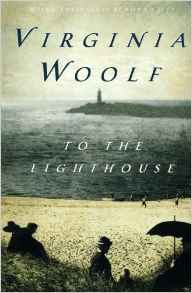
To The Lighthouse –Virginia Woolf
A Farewell to Arms – Ernest Hemingway 
Three Lives – Gertrude Stein
New York Review of Books

On Freedom From Religion

Photo by Aaron Burden on Unsplash

BELIEVE AND YE SHALL BE SAVED?

Do parents have the right to indoctrinate their children?

For millennia, most cultures have acted as if the answer is ‘yes’ — using everything from physical violence to threats of damnation to ensure each successive generation followed like sheep.

Now, finally, someone, somewhere has said, ‘no’.

In December 2022, Japan announced a law to protect children from parental religious fanaticism. The law would protect kids from being a) forced to participate in religious activities, b) refused medical treatment, educational or social opportunities based on their parents’ religious beliefs and c) protect them from religious coercion, i.e. being pressured by parents threatening them with hellfire.

My husband, brought up Southern Baptist, and I (Evangelical then Seventh-Day Adventist) raised our eyebrows: if only.

To quote ‘Giest’, discussing the Japanese legislation on r/atheism: “Most Americans would loose their shit over this. Forcing religion on kids is a big part of our culture.”

FREEDOM FOR SOME

The United States gets mentioned a lot in the reddit thread because perhaps no other country so full-throatedly proclaims its hypocrisies. Individual personal freedom, including freedom of religion, is enshrined in the First Amendment to the Constitution but few other nations match the United States’ fanatical zeal for enforcing minority religious practices on everyone.

Texas just passed a law demanding that the Biblical Ten Commandments be posted in a ‘conspicuous place’ in every classroom in the state. Florida wants to ban any mention of menstruation before sixth grade (12 years old), though which chapter of the Bible supports that blend of misogyny, gynophoby and science-loathing is not specified.

As anyone with two brain cells to rub together can see, the US Right believes only in the absolute personal freedom of wealthy, fanatical, embittered, power-drunk, humanity-hating men. The rest of us be dammed.

Hence the chances of laws to protect children from emotional, psychological and physical abuse in the name of God will remain unwritten and unenacted.

PERSON OR PROPERTY?

This isn’t just a United States problem, though; nor is it only a problem of religion in the States.

The real but unarticulated debate is this: are children people, entitled to the rights and privileges of personhood? Or are they, as the American Right, and so many other cultures construct them, property?

How a society answers this question is of existential importance for the simple reason that children become adults.

A culture, religious or national, that views children as property cannot prepare them for a successful adulthood. Responsibility, the ability to carry oneself in the world, cannot be conferred at an arbitrary age: 18, 21, whatever.

Children who are controlled, brain-washed, browbeaten throughout their youth aren’t going to suddenly blossom into self-sufficient, competent adults. Instead, they are turned loose on society as adult-sized toddlers, prone to tantrums and destruction.

I don’t believe it is any coincidence that the United States combines high rates of religious fundamentalism with catastrophic rates of interpersonal violence. Should we be surprised that children denied agency and personhood seek extreme and harmful outlets as older teenagers and adults? Is anyone surprised when a beaten dog bites?

Photo by Artem Kniaz on Unsplash

TOUGHER. BETTER.

The only way to rear children to become full citizens of humanity is to, quelle surprise, treat them like human beings. From their first breath onwards.

“Childhood is a time for gathering and developing the assets necessary for full autonomy,” writes Hollingsworth (2013). Developing the capacity for full autonomy requires independent trial-and-error, in the same way developing the capacity to ride a bike requires time spent wobbling up and down the street.

Adults can screw this up in so many ways: laziness, authoritarianism, over-protectiveness.

It is tougher to co-regulate, discuss, take time to listen to a child than it is to demand compliance, or at least the appearance of it.

But it is better.

Children learn respect by example. If we want them to grow into adults who respect the opinions, privacy and autonomy of others, we had better show them how its done. Treating children as full-fledged human beings is the best way to inoculate them against hateful ideologies that thrive on repression: nationalism, racism, sexism, transphobia, homophobia and the like.

As educators, we have the extra privilege and responsibility of making our classrooms safe for ideas and self-expression. When children express ideas we find difficult (as they will) we have to model an appropriate, adult, respectful response.

Once, I was teaching English to a group of 14-and-15-year-old Spanish kids. One of them came out in support of Vox, the ultra-nationalist, uber-misogynist far-Right party that had formed recently.

My kneejerk response was: ‘We’ll have none of that in here.

But I pulled myself together and asked why he supported them, and we had a class discussion. Who knows whether he changed his mind about Vox, then or later, but at least he had a chance to participate in a respectful debate, instead of being shut down.

Teachers, and parents, have to model the behaviours and responses they hope to see in children. If we want kids to become thoughtful, compassionate, self-respecting, respectful global citizens we better start working on ourselves.

How do you support your students/kids to develop autonomy? Share in the comments or Tweet @CilaWarncke

My Life in Music

Photo by Hennie Stander on Unsplash

As mentioned in a previous post, I have written for online indie zine Pennyblackmusic for the better part of a couple of decades. One of my recent projects was a series of interviews about my fellow writers, which concluded with one of my fellow writers interviewing me. As my editor, John Clarkson, put it:

“For the last two years in her ‘A Life in Music’ column Cila Warncke has talked to several of our writers and photographers about how music has affected and influenced them. We were interested in finding out in ‘A Life in Music’ what ignited a bunch of obsessives’ passion for music, and discovered that much of our team had lead lives that were just as fascinating as many of the bands. Now that column is coming to an end, and in the last in the series we have turned the tables on Cila and Nick Dent-Robinson has spoken to her about her ‘Life in Music’.”

This may well be the first time I’ve been interviewed in print so thought I’d share.

Cila Warncke: A Life in Music by Nick Dent-Robinson

Cila Warncke is one of the earliest contributors to Penny Black Music magazine, having started writing for them more than two decades ago. Penny Black founder and editor John Clarkson recalls that Cila’s first interview for the magazine was with Cinerama about their “Disco Volante” album. She was the magazine’s first female writer and, as John Clarkson says, he is proud that Cila paved the way for many more excellent female music writers in Penny Black Music over the coming years – as rock music writing was notorious for being too much of a “boys’ club”.

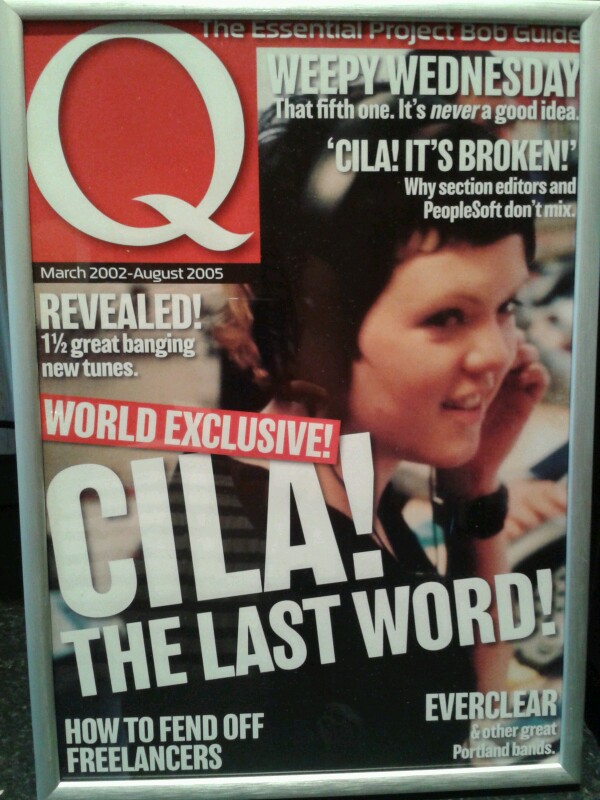
As a professional journalist, Cila says she was attracted by the scope for originality and independence (and lack of male chauvinism) at PBM – and she has produced a fascinating range of articles over her time there. Although she left Penny Black Music in the early 2000s and worked on the glossy London-based music magazine, ‘Q” she was welcomed back in 2012 and has been a regular contributor since then. She has written about the impact of the pandemic on those working behind the scenes in the world of live music, about the eventual demise of ‘Q’ magazine and she wrote a very thoughtful piece about Marilyn Manson. Plus she has produced excellent articles on so many other diverse topics.

Cila also originated the ‘A Life In Music’ series where she probed fellow contributors to PBM about their musical tastes, background and aspirations. – All done with great tact, sensitivity and diplomacy plus insight – key hallmarks of Cila’s style. That series is now drawing towards its conclusion – but not before we turn the tables and seize the opportunity to ask Cila about her own ‘Life In Music”’

Born in 1980 and raised in a small town in Oregon over on the West side of the USA, in her late teens Cila moved to the East Coast to study English at the University of Pennsylvania in Philadelphia – an esteemed Ivy League institution. Subsequently she moved to London to undertake further studies at King’s College before becoming a journalist. She thrived in the UK, enjoying all the many cultural opportunities available just after the turn of the millennium as well as the proximity to Europe. She and her fellow-American husband Chris Hall, a production audio technician in the world of live music, have travelled widely and have now made their permanent base in Valencia, Spain. Cila was at her home in Valencia when I started to ask about her ‘Life in Music’.

What are some of her earliest musical memories?

“Well, my parents weren’t musicians and because my mother was an Evangelical Christian, anything that wasn’t a hymn or soft God-rock was not too popular. It was a cool, rebellious thing to listen to anything other than that. My sister and I would listen to local radio, though and so I got some of the sound of late 80s/early 90s rock and pop culture through that. But my brother – who is around 6 years older than I – loved The Smiths, The Cure and some of the other British post-punk/new wave bands. I enjoyed that sound and I recall some of the record sleeves up on my brother’s wall – brilliant images which made a lasting impression.

The first (non-Christian!) record I remember buying when I was 13 or 14 was Sting’s “Fields of Gold…Best of: 1984-94” and my sister (who was 8 years older and much cooler, always) bought me Green Day’s ‘Dookie’ – which I still think is a great record!”

Read the rest of the interview at Pennyblackmusic.co.uk

10 Sex Affirmative Books for English Language Arts

Following on from my previous post on the importance of affirmative sex education, here are 10 books English Language Arts teachers can reach for to open conversations about love, relationships, gender and sexuality.

These works were chosen because they treat sex with the openness, thoughtfulness, honesty and sensitivity it merits.

Photo by CHUTTERSNAP on Unsplash

Letters to a Young Poet by Rainer Maria Rilke

This brief, moving book touches an many aspects of life: education, self-discovery, solitude, family relationships, etc. but Rilke’s comments about love and sex shine. Don’t be satisfied with conventional definitions of what a relationship ‘should’ look like, he advises. Instead, seek to develop yourself as an individual so you can truly respect and cherish the individuality of another person. It is humane, wise, timely wisdom framed in sublime prose.

Get it here

Frankly In Love by David Yoon

This YA novel centers on Frank Li, the teenage son of Korean immigrants, who finds himself trying to navigate the challenges of new love while wrestling with contradictory cultural expectations. Fast, good-humored and, well, frank, it highlights the importance of being honest with oneself and others — in life and in love.

Get it here

Cool for the Summer by Dahlia Adler

With a nod to Demi Lovato, this novel explores how issues of class and privilege complicate the already complicated issues of love and sexual identity. Are Lara and Jasmine really falling in love, or are they just cool for the summer? And what happens if Lara chases the hunky Chase…? A touch frothy, but heartfelt and affirmative of love, wherever one finds it.

Get it here

Lawn Boy by Jonathan Evison

This Bildungsroman set in a well-to-do Pacific Northwest community hit home with me (though the community I grew up in wasn’t quite so well-to-do). In addition to being a welcome, thoughtful discussion of class, poverty and family tension, it has a romantic twist that is sure to get students talking.

Get it here

A Tree Grows in Brooklyn by Betty Smith

Smith’s beloved coming-of-age tale set in early 20th century Brooklyn is refreshingly forthright about sex. It handles both positive and negative aspects of love and sexuality (including an attempted sexual assault) with a calm directness that can set the tone for open, non-judgmental classroom conversations.

Get it here

Giovanni’s Room by James Baldwin

Baldwin is perhaps my favorite writer on sex; certainly, the rare (American) author who understands and treats sex as the physical act of love. This short novel is appropriate for older teenagers, say 16-18, and explores the tragic consequences of prioritising social conventions over human relationships. To paraphrase Baldwin, the protagonist’s problem isn’t his homosexuality, it’s that his capacity for love has been crippled by his anxiety about what people might think.

Get it here

Genderqueer: A Memoir by Maia Kobabe

Contemporary writers are creating a robust canon of books about gender identity and nonconformity. I love this graphic memoir for its matter-of-fact tone and authenticity. It highlights that gender identity is fluid and finding one’s path isn’t necessarily a linear journey — nor does it need to be.

Get it here

Persepolis 2: The Story of a Return by Marjane Satrapi

Lest you get the wrong impression about the back-to-back graphic memoir recommendations, let me quote one of my students when asked if he liked graphic texts: ‘No!’

He and I share the view that other people’s pictures get in the way of the (superior) moving pictures in our heads.

That notwithstanding, Persepolis 2 is an evocative, eye-level portrait of Satrapi’s struggles with language, culture, love and sexuality after she moved from Iran to Germany. This is a particularly strong choice for children who have immigrated or come from a cultural/familial context that distinguishes them from their classmates.

Get it here

Zenobia July by Lisa Bunker

For younger readers, this is a charming, uplifting novel about a trans girl coming into her own. Details like Zenobia stressing out about which restroom to use add verisimilitude and the plot touches on vital issues like deadnaming, cyberbullying and the importance of community without ever feeling preachy.

Get it here

When I Grow Up I Want to Be a List of Further Possibilities by Chen Chen

Sometimes, I read a book and think, wow, that was brilliant.

Sometimes, I read a book and think, wow, that was brilliant and I really want to be friends with the author.

When I Grow Up… is in the latter category. His poems about growing up as the child of immigrants, cultural tension, sexual identity, homophobia and the search for love are surpassingly deft, raw, funny, tragic, playful and defiant. They also communicate (don’t ask me how) a deep, fundamental good-personness. In a perfect parallel universe, Chen and I would go for drinks.

Get it here

What texts would you add to a literary discussion of love, gender and sexuality? Share in the comments or Tweet @CilaWarncke