6 – Trembling Blue Stars

The following excerpt is from an interview I did for Pennyblackmusic in Dec ’01 or Jan ’02. I’d only been in London a couple of months and found the West End as dizzying as did Mr Wratten. Despite being one of my first profiles, this remains one of my favourite pieces. You can read the full feature at Pennyblackmusic.

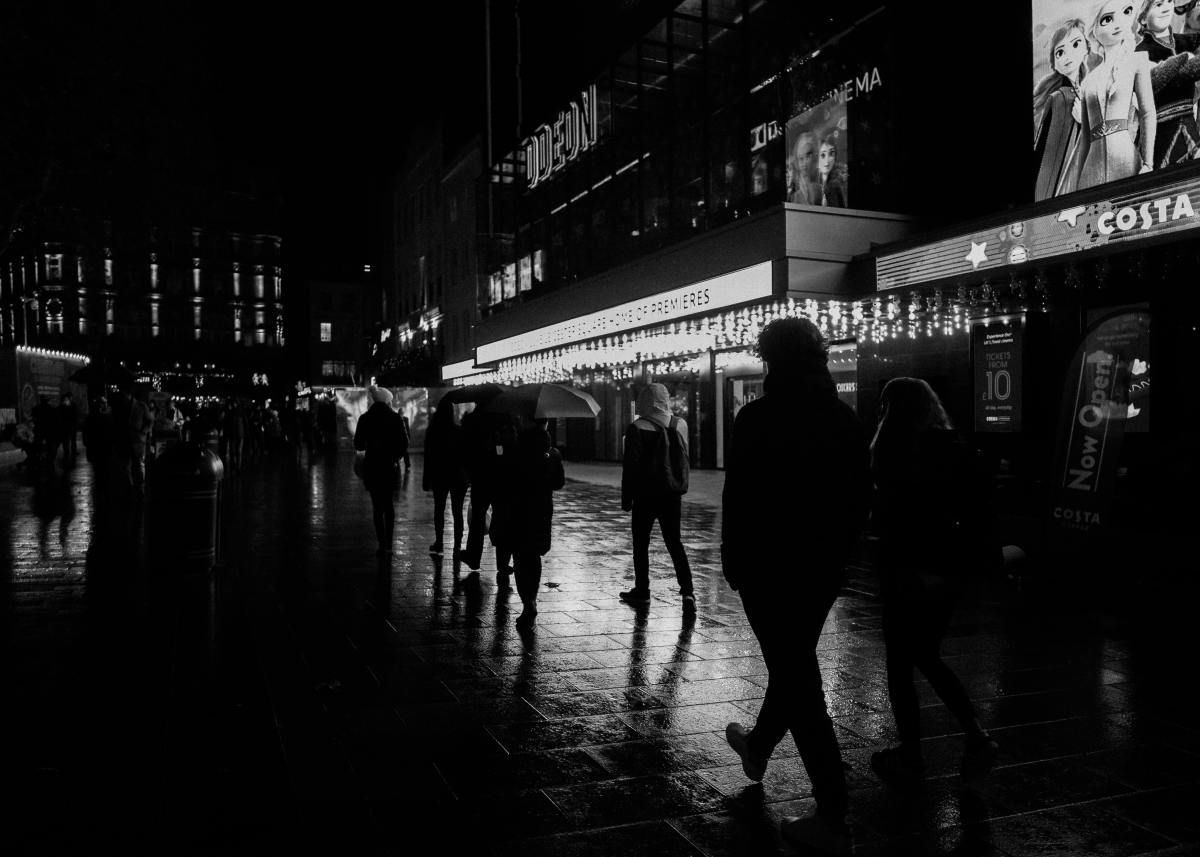
Photo by John Higgitt on Unsplash

The first thing you’ll notice about Trembling Blue Stars frontman Bobby Wratten is that, well, nothing stands out. No requisite dangling cigarette, no Mick Jagger sneer, not even any Bono specs, just a very slender, slightly balding man with light hair, blue eyes and a spaniel smile; a thoroughly unprepossessing rock star. Not that Bobby would like the term rock star: too clichéd, too aggressive.

Wratten doesn’t appear to be fond of the hectic or overstated. Even on a weeknight the routine bustle of London’s West End seems to unnerve him slightly. And he only looks marginally more comfortable settled into a low-lit pub. He’s not, it turns out, drinking orange juice in deference to his slight cough; he just doesn’t drink. Most of the nervousness, though none of the soft-spoken courtesy evaporates though as Wratten begins to talk about what really interests him – his music.

Though for someone who has devoted his life to making music, Wratten didn’t have a particularly polished beginning. Wratten confesses that he and [bassist] Michael Hiscock “couldn’t even tune our guitars,” in the early days of his first band, The Field Mice. When asked how their now-cultishly-adored whispery, twee-pop style developed he smiles, “you copy the bands you like and get it wrong, so that’s where you end up.” But press on and ask what bands he liked as a youngster and he rather incongruously names The Jam, The Clash, XTC, and Joy Division.One wonders exactly what strange things have to happen to bass and guitars, etc to get – accidentally – from The Clash to The Field Mice, but then the studied innocence of Wratten’s expression hints that he’s being more than a little disingenuous. And when he adds that, “there was nothing deliberate about any of it” it seems certain that the dim light of the pub is masking a twinkle in his eye.

After all, he insists that his music is neither as sad, nor as obsessive as some might like to believe. The acrimonious break-up of The Field Mice is well documented, as is the subsequent formation of Northern Picture Library by Wratten, and fellow former-Field Mice Annemari Davies and Mark Dobson. Even more legendary is the break-up of Annemari and Bobby’s long-term relationship, which led to the dissolution of Northern Picture Library after just one album and a handful of singles.

A self-professed incurable romantic, Wratten says, “like the idea you have a soul mate,” which goes a considerable way towards explaining the raw sadness captured in many of his lyrics. “I wrote a lot of songs about Annemari,” he says, perhaps understating the case just a little. The Trembling Blue Stars debut ‘Her Handwriting’, released in 1994, is an unabashed hankie-wringer of a CD recording the emotional devastation that came in the wake of the split with Davies. Unsurprisingly, Wratten reports that Davies declined to sing on ‘Her Handwriting’, though by the time he’d written the second Trembling Blue Stars record, ‘Lips That Taste Of Tears’ his ex-girlfriend was ready to rejoin him in the studio.

Which he claims is not at all creepy, in an “Every Breath You Take” kind of way. “I don’t [write songs about Davies] anymore but people still think I am, it’s just kind of funny,” he says. Then by way of supporting evidence points out a lyric from the third TBS record, ‘Broken By Whispers’: “it goes, ‘the way we left it was you would call,’ [from ‘Sometimes I Still Feel The Bruise’] which I thought made it pretty obvious that it was about someone you weren’t in contact with, but Annemari was in the studio with me when I recorded it!” What’s more, he says, they are good friends outside the studio as well; Davies minds his house for him when he’s away. Which, most recently, was on Trembling Blue Stars inaugural tour of the States. Their American label, Sub Pop funded a multi-city junket, which Wratten thoroughly enjoyed. “[We’re] treated more seriously [there]” he says; possibly, one imagines, because Americans prefer to forgo the irony that Britain almost requires of its musicians.

Not that all their tour was spent in front of fawning audiences; in Portland, OR Trembling Blue Stars were booked to play a club called Dante’s – a seedy gay/leather sort of club.“ There were a few people in front who were there to see us, and a lot of people who just looked confused… but there were no disasters” Wratten recalls. Playing bars and clubs also meant that the shows tended to start late, after a long day of driving (the band navigated all the way from New York to San Francisco in the course of their tour), so “you play the first song three times as slow as it should be.” And instead of throwing yourselves a backstage shindig afterwards, apparently, you pack up and climb back into the van for some kip. “We weren’t very rock’n’roll,” Wratten explains, unnecessarily.Though in a world where“quiet is the new loud”, sleeping, chatting, and hanging out at truck stops may be new rock’n’roll.

In any case, returning to Mitchum, South London was a bit of a jolt, “it felt really strange coming home to nothing… we don’t really know what happens next,” he says, betraying for the first time a sense of anxiousness. This has something to do with their bassist leaving the band at the end of the American tour, and perhaps more to do with the fact that Trembling Blue Stars have already far overreached their intended lifespan. Her Handwriting was meant to be a one off record, and now, four albums later Wratten still believes you should “treat each record like it’s the last one you’re ever going to make.” Great for raising the artistic stakes probably, but surely stressful?

Read the full feature at Pennyblackmusic.co.uk
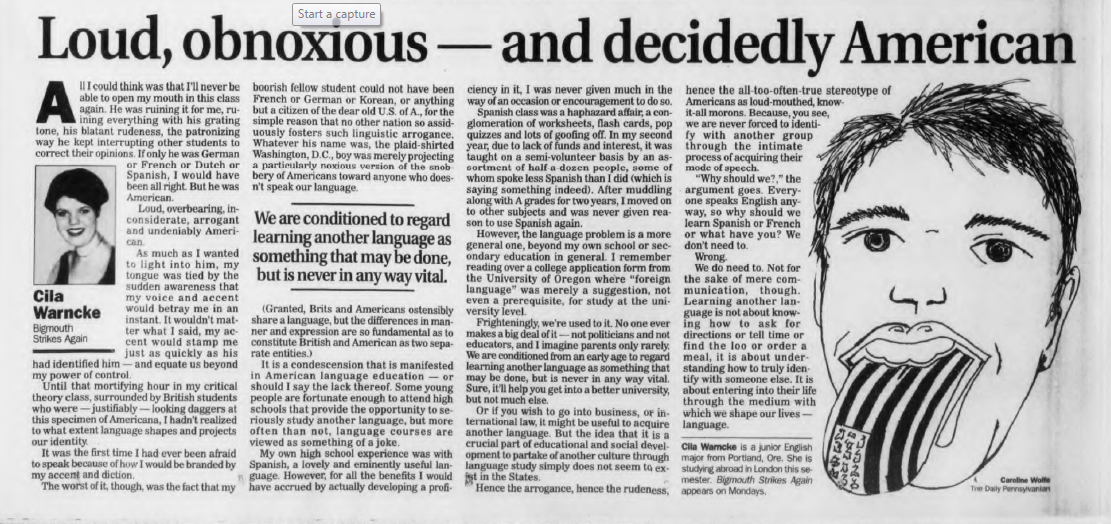
5 – Loud, obnoxious, American

This column appeared in The Daily Pennsylvanian 21 years ago, on 31 January 2000.

Speak up!

Loud, obnoxious – and decidedly American

All I could think was that I’ll never be able to open my mouth in this class again. He was ruining it for me, ruining everything with his grating tone, his blatant rudeness, the patronizing way he kept interrupting other students to correct their opinions

If only he was German or French or Dutch or Spanish, I would have been all right. But he was American. Loud, overbearing, inconsiderate, arrogant and undeniably American.

As much as I wanted to light into him, my tongue was tied by the sudden awareness that my voice and accent would betray me in an instant. It wouldn’t matter what I said, my accent would stamp me just as quickly as his had identified him — and equate us beyond my power of control.

Until that mortifying hour in my critical theory class, surrounded by British students who were —justifiably — looking daggers at this specimen of Americana, I hadn’t realized to what extent language shapes and projects our identity.

It was the first time I had ever been afraid to speak because of how I would be branded by my accent and diction.

The worst of it, though, was the fact that my boorish fellow student could not have been French or German or Korean, or anything but a citizen of the dear old U.S. of A., for the simple reason that no other nation so assiduously fosters such linguistic arrogance.

Whatever his name was, the plaid-shirted Washington, D.C., boy was merely projecting a particularly noxious version of the snobbery of Americans toward anyone who doesn’t speak our language. (Granted, Brits and Americans ostensibly share a language, but the differences in manner and expression are so fundamental as to constitute British and American as two separate entities.)

It is a condescension that is manifested in American language education — or should I say the lack thereof. Some young people are fortunate enough to attend high schools that provide the opportunity to seriously study another language, but more often than not, language courses are viewed as something of a joke.

My own high school experience was with Spanish, a lovely and eminently useful language. However, for all the benefits I would have accrued by actually developing a proficiency in it, I was never given much in the way of an occasion or encouragement to do so.

Spanish class was a haphazard affair, a conglomeration of worksheets, flash cards, pop quizzes and lots of goofing off. In my second year, due to lack of funds and interest, it was taught on a semi-volunteer basis by an assortment of half-a-dozen people, some of whom spoke less Spanish than I did (which is saying something indeed). After muddling along with A grades for two years, I moved on to other subjects and was never given reason to use Spanish again.

However, the language problem is a more general one, beyond my own school or secondary education in general. I remember reading over a college application form from the University of Oregon where “foreign language” was merely a suggestion, not even a prerequisite, for study at the university level.

Frighteningly, we’re used to it. No one ever makes a big deal of it—not politicians and not educators, and I imagine parents only rarely. We are conditioned from an early age to regard learning another language as something that may be done, but is never in any way vital.

Sure, it’ll help you get into a better university, but not much else. Or if you wish to go into business, or international law, it might be useful to acquire another language. But the idea that it is a crucial part of educational and social development to partake of another culture through language study simply does not seem to exist in the States.

Hence the arrogance, hence the rudeness, hence the all-too-often-true stereotype of Americans as loud-mouthed, know-it-all morons. Because, you see, we are never forced to identify with another group through the intimate process of acquiring their mode of speech.

“Why should we?,” the argument goes. Everyone speaks English anyway, so why should we learn Spanish or French or what have you? We don’t need to.

Wrong.

We do need to. Not for the sake of mere communication, though.

Learning another language is not about knowing how to ask for directions or tell time or find the loo or order a meal, it is about understanding how to truly identify with someone else. It is about entering into their life through the medium with which we shape our lives – language.

Cila Warncke is a junior English major from Portland, Ore. She is studying abroad in London this semester. Bigmouth Strikes Again appears on Mondays.

4 – Deaf Stereo

Profile of a short-lived indie electro outfit written for Clash sometime in ’06 or ’07

Photo by Rocco Dipoppa on Unsplash (NB: Not Deaf Stereo)

Deaf Stereo

Deaf Stereo has been percolating ever since Luke, Will and Ben met at Westminster Uni on a music course, at the turn of the millennium. It was four years before they had a name and an idea to go with it. “We decided to stop playing stuff we thought we should, and play music we wanted to listen to,” they explain. The music they wanted to play, if their first single is anything to go by, is solid, grooving beat driven indie pop. Disco biscuits with a side order of Jack Daniels, say.

“We’re into bands like the Chemical Brothers, Underworld… we like the peaks and troughs of dance, but we also wanted proper songs,” says Barney, who describes his role in the band as doing “keyboards and laptop stuff.” About a year ago, they completed their set up, with fifth member, Tom, the clean-cut drummer.

Sitting in the trendy bowels of the Hoxton Bar & Kitchen, it’s Will, who plays bass, who keeps up the steadiest stream of patter. A series of wry asides from behind a hand rolled cigarette. “Would I ever sail a giant effigy of myself down the Thames? Shit. If I were as big as Michael Jackson that’s the least I would do. I’d have a whole set of them.”

Ben, (guitars, backing vocals) is small, dark, thoughtful. He takes on the philosophical questions. Or rather, turns questions philosophical. If you had a band uniform, say, what would it be? Luke (singer) runs a hand through his beautifully cut hair and says, “That’s something we’re still thinking about.” But Ben launches into an earnest and articulate explanation of the dangers of embracing style over substance. Absorbing this, Luke effortlessly readjusts his stance on the issue. “We happy wearing what we wear. No one’s told us to change anything yet.”

These small, subtle realignments happen more than once. Not in a deliberate presenting-a-united-front kind of way, but in a fluid manner which suggests long practice in accommodating each other’s ideas and opinions. Disagreements are minor: Barney prefers Addlestone cider, while Ben is happiest drinking mojitos. Will predicts a Dire Straits revival to general eye-rolling. When it matters, they’re in perfect sync. They want the right songs on the album (“we have a reputation as a party band, but we have some slower songs too, we want to showcase that”); they like the same venues (Koko and Fabric, where they played a riotous 3am gig); and perhaps most importantly, they all know what they want on their rider: “You mean when we have a rider? We’ll have as much as we can get! We got sandwiches when we were at Brixton, that was great,” Luke says.

So far, they’ve humped their equipment through calf-deep mud to play at Glastonbury last year. They’ve written a raft of songs which will somehow have to be whittled into an album. They’ve learned to party on backstage freebies because “we can’t afford to go out unless we’re playing.” They’ve been given some good advice: “Get a job, sort your life out, stop wasting your time,” Will guffaws. And what advice would they give someone following in their footsteps? Ben and Will catch each other’s eye and chorus, “Get a job! Stop wasting your time!” They all laugh.

3 – Slave to the Wage

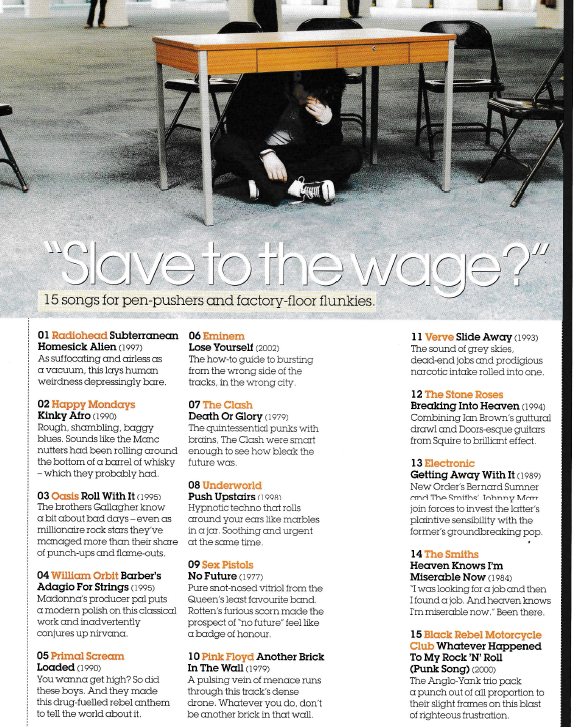
This chart appeared in a Q Special sometime in the early Noughties — ’03 or ’04 perhaps.

01 Radiohead: Subterranean Homesick Alien (1997)

As suffocating and airless as a vacuum, this lays human weirdness depressingly bare.

02 Happy Mondays: Kinky Afro (1990)

Rough, shambling, baggy blues. Sounds like the Manc nutters had been rolling around the bottom of a barrel of whisky – which they probobly had.

03 Oasis: Roll With It (1995)

The brothers Gallagher know a bit about bad days. Even as millionaire rock stars they’ve managed more than their share of punch-ups and flame outs.

Q doing what it did best

04 William Orbit: Barber’s Adagio For Strings (1995)

Madonna’s producer pal puts a modern polish on this classical work and inadvertently conjures nirvana.

05 Primal Scream: Loaded (1990)

You wanna get high? So did these boys. And they made this drug-fuelled rebel anthem to tell the world about it.

06 Eminem: Lose Yourself (2002)

The how-to-guide to bursting from the wrong side of the tracks, in the wrong city.

07 The Clash: Death Or Glory (1979)

The quintessential punks with brains, The Clash were smart enough to see how bleak the future was.

08 Underworld: Push Upstairs (1998)

Hypnotic techno that rolls around your ears like marbles in a jar. Soothing and urgent at the same time.

09 Sex Pistols: No Future (1977)

Pure snot-nosed vitriol from the Queen’s least-favourite band. Rotten’s furious scorn made the prospect of ‘no future’ feel like a badge of honour.

10 Pink Floyd: Another Brick in the Wall (1979)

A pulsing vein of menace runs through this track’s dense drone. Whatever you do, don’t be another brick in the all.

11 The Verve: Slide Away (1993)

The sound of grey skies, dead-end jobs and prodigious narcotic intake rolled into one.

12 The Stone Roses: Breaking Into Heaven (1994)

Combining Ian Brown’s guttural drawl and Doors-esque guitars from Squire to brilliant effect.

13 Electronic: Getting Away With It (1989)

New Order’s Bernard Sumner and The Smiths’ Johnny Marr join forces to invest the latter’s plaintive sensibility with the former’s ground-breaking pop.

14 The Smiths: Heaven Knows I’m Miserable Now (1984)

“l was looking for a job and then I found a job. And heaven knows I’m miserable now.” Been there.

15 Black Rebel Motorcycle Club: Whatever Happened to my Rock’n’Roll (Punk Song) (2000)

The Anglo-Yank trio pack a punch out of all proportion to their slight frames in this blast of righteous frustration.

2 – Taste of Myanmar

This was from a 2013 recipe column, written after a trip to Myanmar.

Photo by Chinh Le Duc on Unsplash

A Taste of the Shan state, Myanmar

After fifty years of repressive military dictatorship Myanmar (formerly Burma) is a land of mystery. Most of us Westerners know little about it apart from news images of Buddhist monks, pagodas, and Nobel Peace Prize-winning democracy campaigner Aung San Suu Kyi. Though tourism has increased since a democratic government took power in 2010 Myanmar is still the least-explored part of Southeast Asia. Like many first-time visitors I was bowled over by how large and geographically diverse it is.

Almost twice the land mass of Britain, it drives a slender wedge between Bangladesh and India on the west and China, Laos and Thailand on the east. In the space of 10 days my companion and I went from the heat and clamour of Yangon to lush mountains in the Mon state, the arid plains around Bagan, and the otherworldly beauty of Inle Lake in the Shan state.

Set some 3000 feet up in the mountains in the eastern part of the country, Inle Lake is Myanmar’s answer to Lake Tahoe – if Tahoe were populated by artisans, fishermen and farmers rather than frat boys and Valley girls. The inhabitants of this bucolic water world are the most gracious and self-sufficient people we encountered and we were fortunate to see some of the local craftspeople at work making the region’s renowned hand-woven cloth and cheroot cigarettes.

Inle Lake is also justifiably famous for the quality of its produce which is grown on floating island gardens. Their crops include cucumber, squash and tomato, which are the most flavoursome I’ve ever eaten. Shan rice noodles – the quintessential Myanmar fast food – were my favourite culinary find of the trip. The following recipes are my interpretation of two ubiquitous dishes: tomato salad and Shan rice noodle salad. Due to the language barrier I couldn’t ask many questions about preparation and ingredients, so they are based on observation and repeated tastings.

Photo by Robin St on Unsplash

Myanmar tomato salad

As a starter or side for two

  • 2 large ripe red tomatoes
  • 1 large green tomato
  • 1 small red onion
  • 1/3 cup peanuts, coarsely crushed

Preparation:

  1. Slice the tomatoes, being sure to catch the juice
  2. Sliver the onion
  3. Mix the crushed peanuts with the tomato juice
  4. Thoroughly toss all ingredients. Season to taste.

Shan noodle salad

Serves two

  • 6oz of rice noodles
  • 1 cup cress or other fresh green
  • 1 cup bean sprouts
  • ¼ chopped green onion
  • French-fried onion strips
  • Crushed peanuts

Dressing:

  • Dark soy sauce
  • Fresh bird’s eye chilli
  • Garlic

Preparation:

  1. Prepare the noodles according to packet instructions
  2. When cooked quickly toss with the cress, spouts and chopped onions till the greens begin to wilt
  3. Garnish with French-fried onions and crushed peanuts
  4. For the dressing add finely sliced chilli and garlic to the soy sauce and serve on the side

NB: Use tamari instead of soy sauce to make this gluten-free

1 – The Wrongs of the Religious Right

January 27th is my 41st birthday. To mark the occasion I am going to post 41 pieces of my published writing — one a day for the next few weeks. Some are minor triumphs; others capture a moment; others are naive and flamboyant. But they matter, to me anyway, because they are the warp and woof of my life.

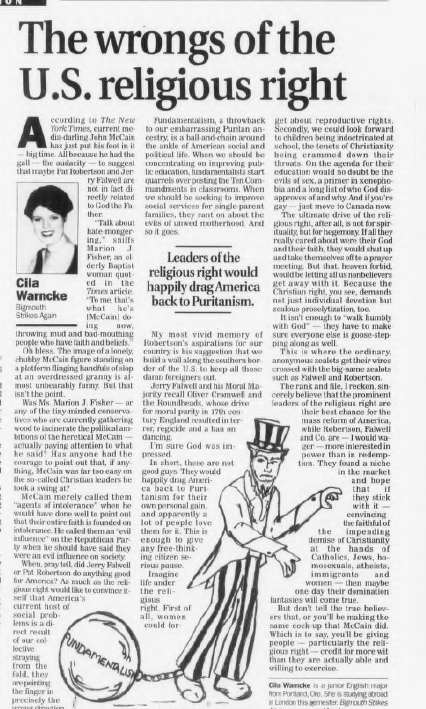
The following column appeared in The Daily Pennsylvanian on Monday, 6 March 2000. The same day, as it happens, that I got my first tattoo before getting blotto at my best friend’s birthday party.

The wrongs of the U.S. religious right

‘Bigmouth Strikes Again’

According to The New York Times, current media-darling John McCain has just put his foot in it — big time. All because he had the gall — the audacity to suggest that maybe Pat Robertson and Jerry Falwell are not in fact directly related to God the Father.

“Talk about hate-mongering,” sniffs Marion J. Fisher, an elderly Baptist woman quoted in the Times article.

“To me, that’s what he’s doing, throwing mud and bad mouthing people who have faith and beliefs.”

Oh bless. The image of a lonely, chubby McCain figure standing on a platform flinging handfuls of slop at an overdressed granny is almost unbearably funny But that isn’t the point.

Was Ms. Marion J. Fisher — or any of the tiny-minded conservatives who are currently gathering wood to incinerate the political ambitions of the heretical McCain —actually paying attention to what he said? Has anyone had the courage to point out that, if anything, McCain was far too easy on the so-called Christian leaders he took a swing at?

McCain merely called them “agents of intolerance” when he would have done well to point out that their entire faith is founded on intolerance. He called them an “evil influence” on the Republican Party when he should have said they were an evil influence on society.

When, pray tell, did Jerry Falwell or Pat Robertson do anything good for America? As much as the religious right would like to convince itself that America’s current host of social problems is a direct result of our collective straying from the fold, they are pointing the finger in precisely the wrong direction.

Fundamentalism, a throwback to our embarrassing Puritan ancestry, is a ball-and-chain around the ankle of American social and political life. When we should be concentrating on improving public education, fundamentalists start quarrels over posting the Ten Commandments in classrooms. When we should be seeking to improve social services for single-parent families, they rant on about the evils of unwed motherhood And so it goes.

My most vivid memory of Robertson’s aspirations for our country is his suggestion that we build a wall along the southern border of the U.S. to keep all those damn foreigners out.

Jerry Falwell and his Moral Majority recall Oliver Cromwell and the Roundheads, whose drive for moral purity in 17th century England resulted in terror, regicide and a ban on dancing.

I’m sure God was impressed.

In short, these are not good guys. They would happily drag America back to Puritanism for their own personal gain, and apparently a lot of people love them for it. This is enough to give any free-thinking citizen serious pause.

Imagine life under the religious right. First, women could forget about reproductive rights. Second, we could look forward to children being indoctrinated at school, the tenets of Christianity being crammed down their throats. On the agenda for their education would no doubt be the evils of sex. a primer in xenophobia and a long list of who God disapproves of and why. And if you’re gay — just move to Canada now.

The ultimate drive of the religious right, after all. is not for spirituality, but for hegemony. If all they really cared about were their God and their faith, they would shut up and take themselves off to a prayer meeting. But that, heaven forbid, would be letting all us non-believers get away with it. Because the Christian right, you see, demands not just individual devotion but zealous proselytization, too. It isn’t enough to “walk humbly with God” — they have to make sure everyone else is goose-stepping along as well.

This is where the ordinary, anonymous zealots get their wires crossed with the big name zealots such as Falwell and Robertson.

The rank and file, I reckon, sincerely believe that the prominent leaders of the religious right are their best chance for the mass reform of America, while Robertson, Falwell and Co. are—I would wager—more interested in power than in redemption.

They found a niche in the market and hope that if they stick with it —convincing the faithful of the impending demise of Christianity at the hands of Catholics, Jews, homosexuals, atheists, immigrants and women — then maybe one day their domination fantasies will come true.

But don’t tell the true believers that, or you’ll be making the same cock-up McCain did.

Which is to say, you’ll be giving the religious right credit for more wit than they are actually able and willing to exercise.

Cila Wamcke is a junior English major from Portland. Ore. She is studying abroad in London this semester. Bigmouth Strikes Again appears on Mondays.

James Baldwin +Black Lives Matter

#BlackLivesMatter
Donate to Black Lives Matter

blm

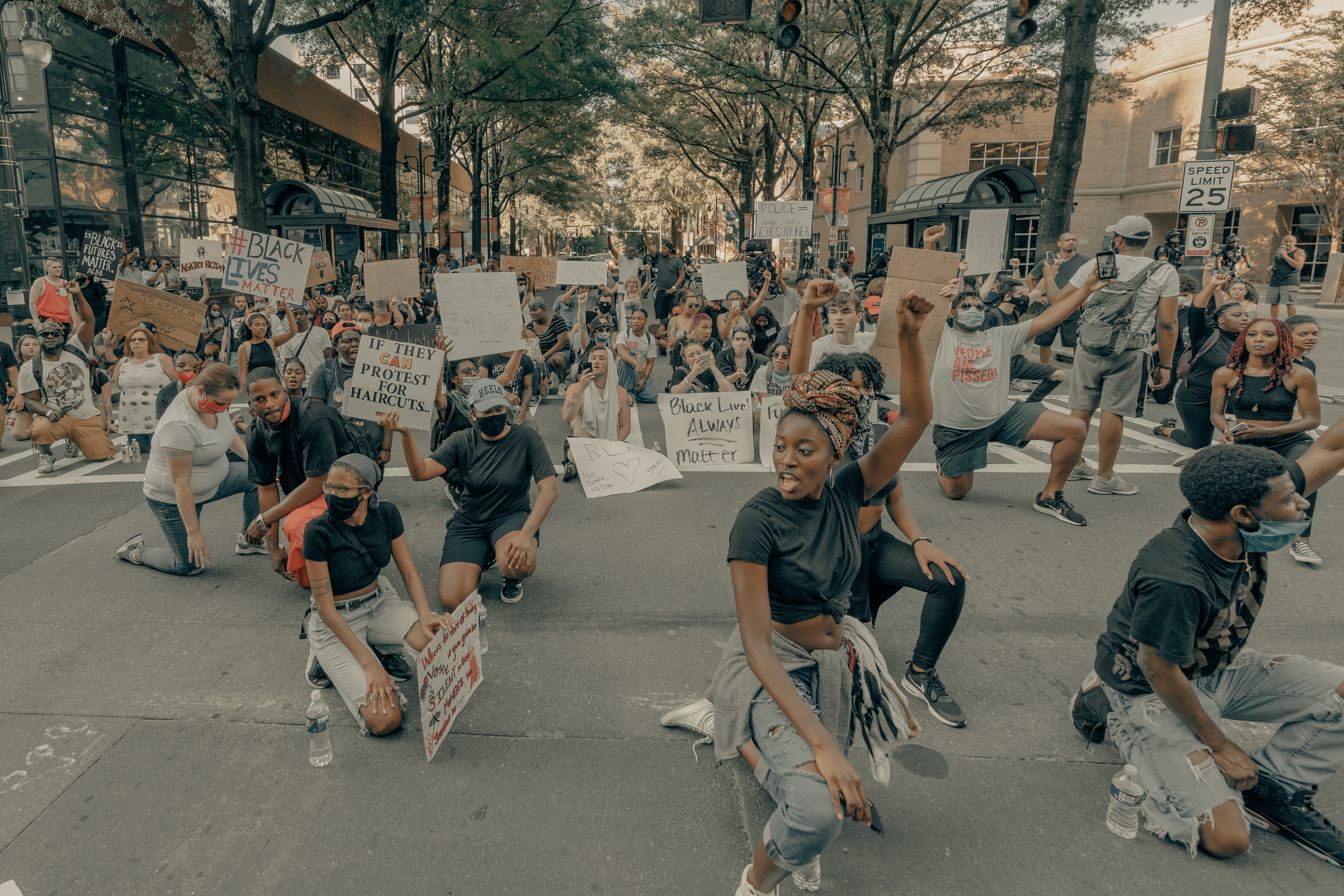
Photo by Clay Banks on Unsplash


The late literary genius and humanist nonpareil James Baldwin spoke for Black Lives Matter decades before the movement gained a name. And as a gay black man, born poor, he understood intersectionality in a profound sense.

Baldwin’s gifts included the ability to study himself and report, however painful or unflattering the truths that emerged. This spawned an empathy as rare as wise. He didn’t excuse cruelty but he acknowledged and, as a writer, rendered in meticulous detail the pain that (often) underlies it.

The following quotes, from interviews and from his fiction, articulate truths that are as urgent and relevant today as when he uttered them.


“Look, we live in Harlem, let’s say, or we live in Watts. The mother who comes down there with his cap and his own gun in his holster, he doesn’t know what my day is like. He doesn’t know why I get drunk when I do. He doesn’t know anything about me at all. He’s scared shitless of me. Now, what the fuck is he doing there? All he can do is shoot me. He’s a hired concentration-camp keeper…. All you can do is bring in tanks and tear gas—and call the National Guard when it gets too tight. And think you can fight a civil war and a global war at the same time.”

Baldwin speaking to Esquire in 1968

“The black cat in the streets wants to protect his house, his wife and children. And if he is going to be able to do this he has to be given his autonomy, his own schools, a revision of the police force in a very radical way. It means, in short, that if the American Negro, the American black man, is going to become a free person in this country, the people of this country have to give up something. If they don’t give it up, it will be taken from them.”

Baldwin speaking to Esquire in 1968

“The country has got the police force it deserves, and of course if a policeman sees a black cat in what he considers a strange place he’s going to stop him—and you know of course the black cat is going to get angry. And then somebody may die. But it’s one of the results of the cultivation in this country of ignorance. Those cats in the Harlem street, those white cops; they are scared to death and they should be scared to death. But that’s how black boys die, because the police are scared.”

Baldwin speaking to Esquire in 1968


“I’d learned how to get by. I’d learned never to be belligerent with policemen, for instance. No matter who was right, I was certain to be wrong…. I only had one head and it was too easy to get it broken… I figured out what answers he wanted and I gave them to him. I never let him him think he wasn’t king.”

‘Previous Condition’ in Going to Meet the Man

“Those boys, now, were living as we’d been living then, they were growing up with a rush and their heads bumped abruptly against the low ceiling of their actual possibilities. They were filled with rage.”

‘Sonny’s Blues’ in Going to Meet the Man

“For everyone’s life begins on a level where races, armies, and churches stop. And yet everyone’s life is always shaped by races, churches, and armies; races, churches, armies menace, and have taken, many lives.”

‘This Morning, This Evening, So Soon’ in Going to Meet the Man

“To be forced to excavate a history is, also, to repudiate the concept of history, and the vocabulary in which history is written; for the written history is, and must be, merely the vocabulary of power, and power is history’s most seductively attired false witness…. One thing is absolutely certain: one can repudiate, or despise, no one’s history without repudiating or despising one’s own. Perhaps that is what the gospel singer is singing.”

Just Above My Head

“All the years that we spent in and out of the South, I always wanted to say to those poor white people, so busy turning themselves and their children into monsters: Look. It’s not we who can’t forget. You can’t forget. We don’t spend all our waking and sleeping hours tormented by your presence. We have other things to do: don’t you have anything else to do? Maybe you really don’t? Maybe the difference between us is that I never raped your mother, or your sister, or if and when I did, it was out of rage, it was not my way of life… Maybe the difference between us is that I’ve never been afraid of the prick you, like all men, carry between their legs and I never arranged picnics so that I could cut it off of you before large, cheering crowds.”

Just Above My Head


#BlackLivesMatter

Donate to Black Lives Matter

A short quarantine reading list

read

Photo by Lilly Rum on Unsplash

Even before a ton of ordure hit the propeller-style cooling device I’d only read three books this year.

Three. 

Since the age of six or seven I’ve been capable of reading three average-length books a day. Once, when I was about 9, I read 1,000 pages in a day, to see if could.

On another occasion (again, pre-teen) I read The Lord of the Rings trilogy in three days.

The point I’m sidling towards is that it is a sign of spiritual/ emotional/ logistical malaise when my word-consumption dips to such low levels. (The other obvious conclusion is I was backward as a kid, which is fair, but there were reasons.)

Being almost too far gone in anxiety to even read a book is new and unnerving. Books have always been a reliable portal away from the unappetitliche present, but the present present has got me so tied in knots I’m afraid to miss anything.

Initially, I tried to negotiate this in my usual Protestant, eat-your-beet-greens-they’re-good-for-you fashion. That is, I started a book about Palestine. If there is one thing more depressing than coronavirus, it’s the situation of Palestine. Reading about children getting shot with tear-gas canisters and all the other interminable head-fucking brutality of the Israeli occupation was enough to make me think that maybe enough humans are ugly enough that we all deserve to be wiped out by a virus.

Not reading material for these times.

After that failed effort, I didn’t read anything for a few days. Then my friend Nick emailed and it turned out I bought his book (presciently titled It Gets Worse) last year and forgotten to read it. That’s like discovering the bottle at the back of the cupboard you thought was cheap emergency plonk is a fantastic vintage meant for a special occasion.

This is a special occasion.

So, I’m (finally) on my way to having read four books this year. When I finish Nick’s book I may go back and reread his first, Bitter Experience Has Taught Me, because it’s nice to hear a friend’s voice — especially when it is funny, acid, and laden with anecdote.

After that, I’ll try Jane Austen, James Baldwin, Oscar Wilde and Primo Levi.

Disparate, yet equally essential.

All of these writers, including Ms Austen (whose reputation for daintiness is undeserved) exhibit rare levels of integrity, perspicacity and moral clarity. They took the world as it was, but refused to accept the supposed constraints of that relationship.

And they, one and all, write sentences so good I have to pause and let the wave of admiration/envy/admiration pass. Right now, it’s reading for pleasure, or not at all.

book2

Photo by bruce mars on Unsplash


The New Barebacking

I had to go to the village today.

maks

Photo by Kate Trifo on Unsplash

On the short drive to the village a couple of cars passed heading the opposite direction, both drivers wore surgical masks.

In the taxi rank in the village a driver leaned against the hood of his car, mask tucked beneath his chin, smoking.

The receptionist and vet wore blue masks.

The middle-aged man with the shock of dark curly hair who passed me on the sidewalk wore a white N95 mask.

The lady carrying two armloads of groceries wore a mask.

The young dude unlocking his car wore a mask.


Barefaced and bare-handed, I felt like a lowlife misfit.

Appearing in public sans mask is the new barebacking. Socially irresponsible, verging on reprehensible.

On arriving home, I decided it was time to buy masks (Amazon orders are delivering a month out, so thanksthefuckverymuch Jeff Bezos, I’m off elsewhere).

covid 1

Covid Photo by pixpoetry on Unsplash

Why the previous reluctance?

Because I don’t want to walk around thinking the next breath is going to kill me, or someone else. For the first time, I have an inkling how some men feel about condom use. Yeah, sure fine it’s the most appropriate thing to do but goddamn it, who wants to experience the world through a prophylactic shield?

Cherry blossoms are out, yellow wands of broom, did I mention the walnut trees are leafing? The air is pristine, sharp and Atlantic-cold. Our neighbor trundles up and down the road in an old red tractor, moving wine-sweet hay bales.

I do not want to touch the world with rubber fingers and breathe through layers of activated carbon. Why the hell would I sign up for that? Why not just lock myself in a sterile box and wait to die?

Okay, it’s not that dramatic but something important is being (has been?) lost in all this. Our sense of touch is already degraded from devoting too much of it to digital screens. We rarely breathe as deeply as we should. This stupid cunning virus is robbing us not just of too many lives but, sneakily, of things that make life worth living.

I’ll probably end up like wearing a mask for the common good (assuming I can beg borrow or steal one) but I refuse to think it is a Good Thing, in a larger sense.

We cannot do without enjoyment, wrote to Jack Gilbert. The ordinary sensual pleasures of filling our lungs and encountering the world through touch are not dispensable.

bench

Photo by Chris Murray on Unsplash


The Future? Don’t Bet on It

Last year, Chris and I spent Easter week with our dear, long-long-long-standing friends
C & R in Yorkshire. On the edge of the moors. Next door, it transpired, to my ex-boyfriend (who, true to form, was smoking on the front porch as I had my first cup of coffee).

Twelve months ago, someone I’d met and dated in Ibiza turning up next-door in a northern English was cause to murmur, small world.

dav

Yorkshire bluebells

Today, proof of the world’s smallness is inescapable and grim. The ticker-tape death toll mounts, the number of official coronavirus cases races towards two million and even the most fortunate of us hunker at home, waiting for a future that might never happen (that’s cribbed from Mavis Gallant, who wrote exquisitely about societies in meltdown and the delusions they cherish on the way to the flames).

There seems to be a split take on COVID-19. Either, it’s going to usher in hitherto unimaginable era of mutual support and higher consciousness or we’re going to be dragged (resisting or not) back into the machine and crushed between the cogs of resurgent capitalism.

The latter argument is ably made by Julio Vincent Gambuto in his viral Medium piece ‘Prepare for the Ultimate Gaslighting‘ in which he writes, plausibly:

What is about to be unleashed on American society will be the greatest campaign ever created to get you to feel normal again. It will come from brands, it will come from government… the all-out blitz to make you believe you never saw what you saw. The air wasn’t really cleaner; those images were fake. The hospitals weren’t really a war zone; those stories were hyperbole. The numbers were not that high; the press is lying. You didn’t see people in masks standing in the rain risking their lives to vote. Not in America.

On the chirpier side of the fence is Rebecca Solnit who writes in ‘The impossible has already happened: what the coronavirus can teach us about hope‘ (published last week in the Guardian):

When a storm subsides, the air is washed clean of whatever particulate matter has been obscuring the view, and you can often see farther and more sharply than at any other time. When this storm clears, we may, as do people who have survived a serious illness or accident, see where we were and where we should go in a new light. We may feel free to pursue change in ways that seemed impossible while the ice of the status quo was locked up. We may have a profoundly different sense of ourselves, our communities, our systems of production and our future.

(To be fair, Solnit is no Pollyanna. Most of her longform piece details how fucked things are and how stacked the cards are against people trying to unfuck them.)

It says something about my own wiring that I feel compelled to take sides, to argue the case. Coronavirus has turned me into armchair experts. Like a sad gambler, I stare at screens, watch the numbers, argue my interpretation of the stats, have opinions about things I zero right to opine about (South Korea’s testing policy! Sweden’s schools!)

This impulse has  to do with lack of control. I value knowing things, having well-formed and well-informed ideas. In other words, I’m an instant relic; a creature who belongs to the bigger yet more predictable world that existed before January 2020.

Taking sides, prognosticating, surmising and supposing are ways to pass the time but little more. (Aside: I was listening to a TED en Espanol talk about coronavirus from 16 March; it felt like  listening to a historical reenactment.)

If this pestilent mess proves anything, it’s that opinion is pretty much beside the point.

Still, if I had place a few bob on an outcome, my money is on business as usual with a twist. Advertisers will come after what’s left of our bank accounts, governments will wrangle for the remaining shreds of our civil liberties, global warming will heat back up and we will not turn into kinder, gentler, better versions of ourselves.

Nonetheless, we may be more attuned to the ludicrousness of the situation, and quicker to say so, to complain or resist. I hope so, anyway.

Above all, a year from now, I hope to be with friends somewhere, drinking, breathing fresh air, gossiping about some minor coincidence. That would be a happy ending.