This was another Ideas Tap feature that was mostly an excuse to interview a handful of my favorite people — dear friend and mentor Paul Hendrickson, another beloved writing friend Nick Lezard, and the man who saved my life during my writing Master’s, course director and prolific author Michael Schmidt.
Want to be a writer? The best way to start is by reading. But how can you make sure you reap the benefits in your own work? Cila Warncke asks writers Paul Hendrickson, Nick Lezard and Michael Schmidt for tips…
“It is impossible to become a writer without reading,” says Paul Hendrickson, writing professor at the University of Pennsylvania and award-winning author of numerous books including, most recently, Hemingway’s Boat.
There is a relationship between quality of reading and quality of writing. And a distinction between reading for pleasure and reading like a writer. The difference involves attitude, approach and appreciation. Michael Schmidt, poet, professor and author of the forthcoming The Novel: A Biography recommends reading, “with eyes wide open, full of anticipation.”
With this in mind, here are seven ways to read like a writer:
1. Compulsively
“You can’t be a writer unless you have a hunger for print,” says Nick Lezard, Guardian literary critic and author of Bitter Experience Has Taught Me. “I was the kid who sat at the table and read the side of the cereal packet.” In Nick’s case, the lust for literature paved the way for a career as a book reviewer. But regardless of the genre or field to which you aspire, all writers are readers first. And “it doesn’t matter whether the medium is the side of the cereal packet or a screen,” Nick says.
2. Slowly
Cereal-packet readers tend to wolf words like they do breakfast. This is a trait writers should train themselves out of – at least sometimes. Paul defines reading like a writer as slowreading: dawdling on the page, delving, soaking in the style and rhythm. Don’t read everything this way, though. “I don’t read the newspaper ‘like a writer’,” he notes. “I don’t have time. Nobody does.”
3. Broadly
Time is of the essence for the reading writer, but that doesn’t mean you should ignore everything apart from the classics. There are, to borrow Orwell’s term, good bad books. Nick mentions Ian Fleming as an example of compelling though less-than-literary fiction. Paul gives a nod to Raymond Chandler, saying writers can learn from his “hardboiled, imagistic lines.”
4. Selectively
That said, don’t make the mistake of reading widely but not too well. “Reading crap is no good for the eye or ear,” says Michael. “Read only the best, and read it attentively. See how it relates to the world it depicts, or grows out of.”
Nick, who has read his share of bad books as a reviewer, concurs: “If you just read books like 50 Shades of Grey, or Dan Brown, you’re going to wind up spewing out a string of miserable clichés.”
5. Attentively
You get the most out of good writing by reading it with real attention. Michael advises writers to pay heed to metaphor, characters’ voices, how the author develops those voices and how they change. He recommends Christina Stead’s The Man Who Loved Children,” as a rewarding subject of attentive reading: “There is a strong sense of development, nothing static there. I can think of no better pattern book for a would-be writer.”
6. Fearlessly
Reading like a writer means going out of your comfort zone. When Nick was in his teens he tackled James Joyce’s Ulysses. “It was a struggle,” he recalls. “It took me a year or two. But that’s how you [learn] – you find stuff that’s above your level.”
7. Imaginatively
Reading above your level is valuable, in part, because it challenges your imagination. Paul talks about savouring the terse beauty of poetry and imagining “everything that’s between the spaces of the words, the spaces of the lines.” By observing the work of your own imagination you gain insight into how writers evoke images and emotions.
You don’t have to read every book (or cereal box) like a writer. But the more you immerse yourself in words and cultivate these seven skills, the better your writing will be. “If you are writing a potboiler, imagine how wonderful it will be if the work you produce is actually a proper novel,” says Michael. “Read the best, and read the best in your elected genre.”
This was written for Ideas Tap, an organization (sadly now defunct) that supported young people pursuing the creative arts. Cheryl Strayed, whose Tiny Beautiful Things was my bible for several months, was as generous and gracious by phone as she is on the page. A case of meeting one’s heroes not going wrong.
After writing her first novel, Cheryl Strayed turned to memoir and wrote her New York Times bestselling book Wild, about her 1,100-mile hike along the Pacific Crest Trail in the wake of her mother’s death. Here, Cheryl tells Cila Warncke about mining memory and sets us to work with a writing exercise…
How does the emotional experience differ between writing fiction and memoir?
It doesn’t. To write fiction well you have to inhabit the consciousness of the characters you’ve created. With non-fiction there’s an extra layer of intensity because the character you’re building is yourself.
When writing memoir, how do you build yourself as a character?
The only way you can build yourself is to dismantle yourself. To take apart who you are, what your assumptions have been, what you hope people think of you. You can’t write: “I’m pretty and cool and awesome and interesting” because everyone would hate you. You have to say: “I’m human. Here are positive things about me. Here are negative things about me. And here are things that don’t make sense, don’t add up, and I’m going to present them to you”. Writing is like the deep work you do in the course of therapy where you take yourself apart.
What memory aids do you use?
I naturally have a very good memory – I think a lot of writers do. I kept a journal through my 20s and 30s. That helped me a lot in writing Wild. I do research where I can, going back and looking at pictures for example. When most people imagine what a memoirist does they think: “I don’t remember anything from high school, from 20 years ago”. But they do remember – they just think they don’t.
How can writers elicit those memories?
The process of writing is re-conjuring memories. It’s doing things so more memories come to you. Even looking at a photo can allow you to remember something accurately. The process is like running into an old friend from back in the day, somebody you knew 20 years ago. When you first start talking you only know a few things about each other. But as you talk and go deeper into your lives you remember things you thought you had forgotten. Just because you haven’t thought of something for years doesn’t mean you don’t remember it, it just means it takes a little work to access it. When I was writing Wild I’d think, “I don’t remember, I just walked” but once I started writing my mind would open up to specific memories.
Do you draw heavily on your own life for your fiction?
You’ll see a lot of details from my life. My next novel is set in Portland [where I live]. None of the characters in the book are me but there are all these little tendrils of the story that you can trace back to me.
I never call it “writer’s block” but I always have trouble beginning. Writing is hard. I resist writing. I run from it. If I am left alone with a laptop I flounder for an hour or two, then I sink in and I’m in the zone. When I get stuck I go for a walk, come back and try again. I don’t force it. If something isn’t coming, I move on; that’s a good strategy for me.
How long did it take to write your first book, Torch?
Your first book is so hard because you don’t know how to write a book and there is no way for anyone to tell you. It turns out the only way to learn how to write a book is to write a book. I avoided finishing [Torch] for fear of failure, until the point where the fear of failing to finish was bigger than the fear of finishing a book that was terrible. I worked on it for about ten years in total, three years really diligently.
Once I let go of the idea that I was going to write a great book, I was able to write a book. I let go of any ego or fear or shame. That was an important moment in my writing life. None of us really knows what kind of book we’re writing. A lot of people think they’re writing brilliant books and they’re terrible. And the reverse is true too. It isn’t up to us to judge our books; it’s up to the people who read them.
In Focus: Writing exercise using objects
I take random objects out of my handbag like lipstick, a ten-euro note, and a pair of sunglasses, and tell my students to pick one and write a story about it.
To begin writing you begin with an image. You begin with a feeling. I encourage people to start writing and not think about it too much. Even if you have a good idea, usually once you start writing it will become something else.
I could do that same exercise with the world’s Nobel Literature Prize winners and something would come of it. Perhaps what came of it would be better than what comes to my students, but that’s how the [Nobel Prize winners] do it too – they begin with something then they make something else.
Gradually, my writing moved beyond all music, all the time. There is a heart of darkness in Ibiza’s club world; the shadows got long. It was time to look at things differently. This piece was written for Tiny Buddha. You can read the full article here.
“Sometimes the past should be abandoned, yes. Life is a journey and you can’t carry everything with you.Only the usable baggage.” ~Ha Jin
You’ve probably heard of the fear of missing out but what about the fear of letting go?
My father was volatile and mentally unstable. Criticism was his preferred method of communication. As a child and teenager, I learned to keep my thoughts and feelings locked away and became an expert at deflecting personal questions.
Without realizing it, I carried this habit into adulthood, avoiding any talk about my feelings or turning them into a joke. When a friend finally called me on it, the shock of self-recognition quickly turned to resistance. This is who I am, I thought. Why should I change?
I plodded on, working as hard as ever to keep my fortress intact. It wasn’t making me happy yet I wasn’t ready to change.
As I struggled with my desire to cling to hurtful memories and self-defeating behaviors, it dawned on me that I was afraid to let go because defensiveness was part of my identity.
The problem wasn’t that I had baggage—everyone has baggage—but that it had come to define me. I didn’t know who I would be without it. At that point it hit me: I had to dig deep, discover the person I wanted to be, and then act on it.
After I identified that I was holding on to the past because it seemed too important to jettison, I discovered that letting go is harder than it sounds. Relaxing a long-held belief isn’t a one-day, one-week, or even a one-year process. However, it is possible.
This feature was for Saveurmagazine in 2011. You can read the full article here.
Ibiza Town. Photo: Cila Warncke
Ibiza may be best known as a party hot spot for all-night clubbing, but its rich history belies its boozy reputation. First settled around 4500 BC, Ibiza (‘Eivissa’ in Catalan) was ruled by Phoenicians, Carthaginians, Romans, Moors and, since 1235, Catalans. The key to its desirability is ses Salinas – the salt flats which have provided seasoning to surrounding countries for three millennia. (Don’t leave without picking up a sachet of Sal de Ibiza, the source of the nickname “the White Island.”)
But salt isn’t Ibiza’s only gustatory delight. Its hilly, pine-scented interior boasts brick-red soil where citrus, carob, figs, olives, peppers, squash, tomatoes, melons and herbs thrive, and the turquoise sea yields exquisite fish – get up early one day and go to the port to watch the fishermen offload the night’s catch. Dining in Ibiza is relaxed; don’t mistake the leisurely pace of service for indolence, since the concept of ‘turning a table’ has yet to take hold, and wait staff expect you to linger. You can eat wonderfully well in Ibiza Town alone, but to appreciate the diversity of Ibicenco cuisine, hire a car to explore the seaside chiringuitos and country restaurants. A final tip: be sure to say si when offered a chupito de hierbas – a shot of the strangely addictive local liqueur is the perfect way to finish your meal.
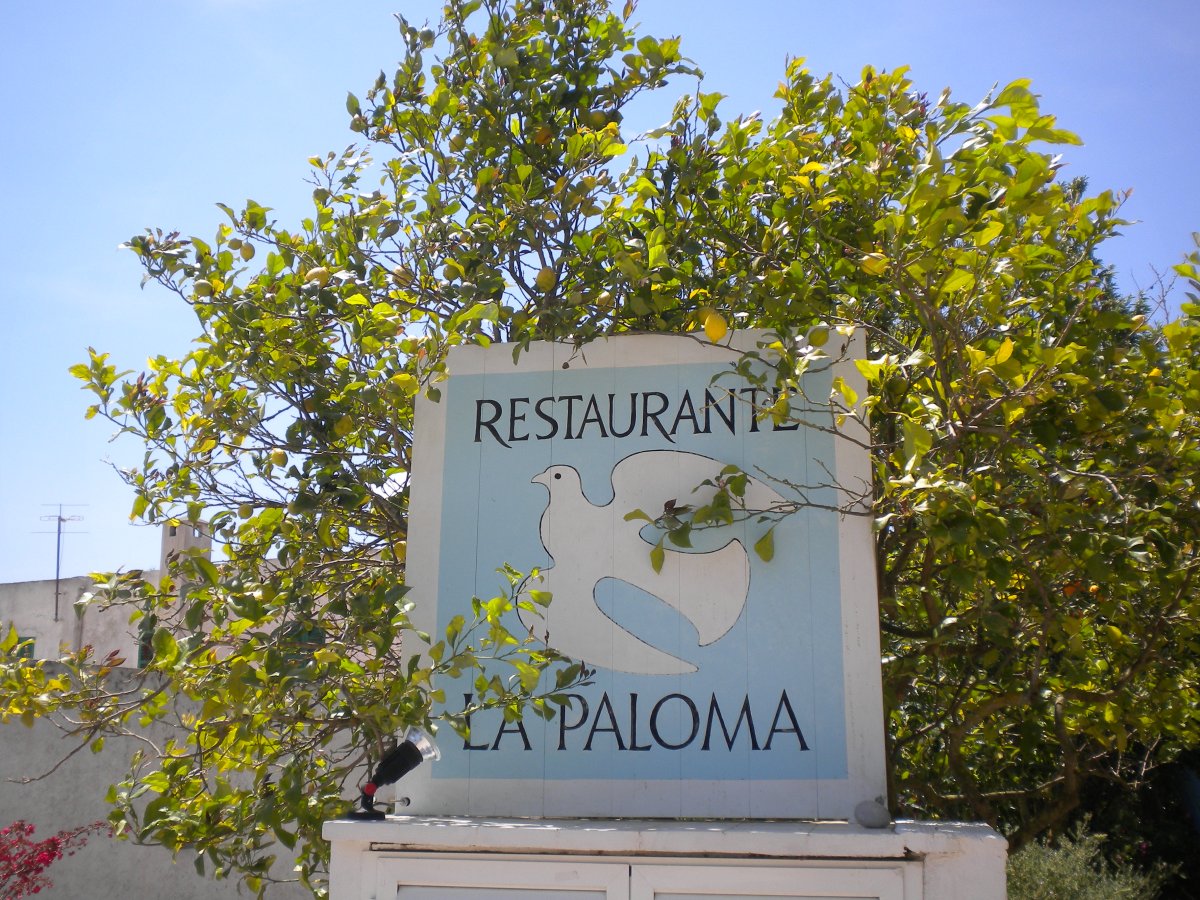
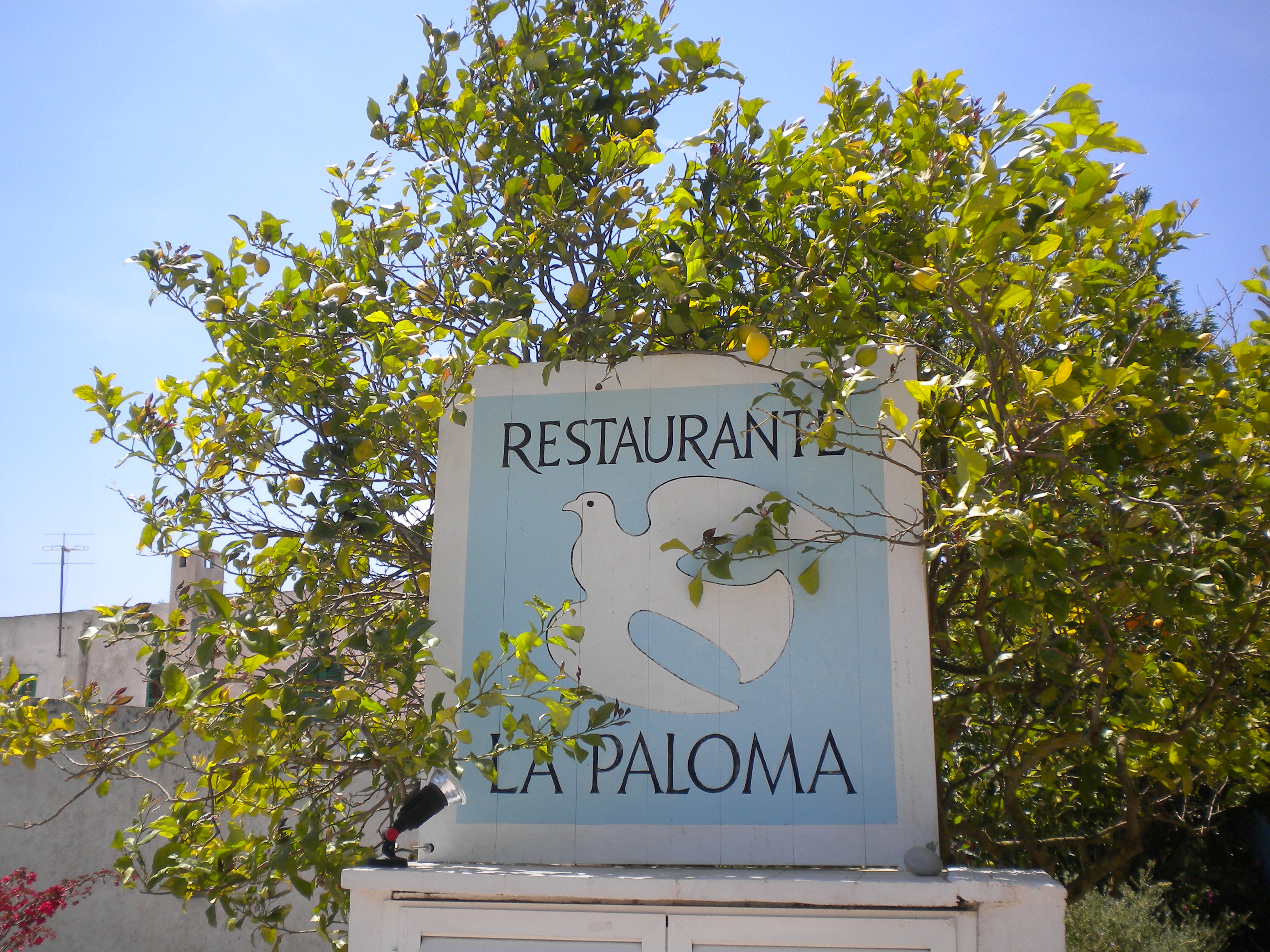
La Paloma Run by two generations of an Italian family, La Paloma is almost unbearably charming. Set in a citrus-fringed corner of the village of Sant Lorenc it is also one of the island’s few vegetarian-friendly spots. The birds and flowers that dance across the walls were hand-painted by local doyenne Orietta, and the food is created with equal love and attention. Lunches are simple affairs: salads bursting with tomatoes, lettuce and herbs from their organic garden; sandwiches on freshly baked focaccia; and crudites served with the sublime hummus. Dinner is simple and robust: steak; risotto; an organic, vegan option that changes daily; fresh fish; and sumptuous desserts.
Es Boldado One absolute must-see is Es Vedra, a limestone islet just off the southwest coast. Reputedly the third most magnetic place on earth, semi-spooky stories abound featuring underwater lights, hovering aircraft, and converging ley lines. Even skeptics admit there is something otherworldly about Es Vedra’s imposing white flanks and one of the best views is from Es Boldado, above the beach of Cala d’Hort. A no-frills fish restaurant, Es Boldado serves up the fattest mussels I’ve ever eaten, paella, its own-recipe seafood stew, and impeccably fresh fish. The cliff-top perch makes it an ideal place to enjoy a glass of wine and watch the sunset.
El Olivo Meals at El Olivo have a delightfully playful sense of occasion, thanks to its prime people-watching location in Dalt Vila’s bustling Plaza de Vila—though once you’re seated, you may have a hard time tearing your eyes away from the feast before you. Chef Frederic uses local produce to create unforgettable dishes like fresh-caught skate with capers and butter sauce, rabbit stew with pickled lemons, and a goat’s cheese stuffed fillet of pork. Like many Ibicenco restaurants it is oblivious to vegetarianism: If you don’t eat meat or fish, you’ll have to make do with just bread, salad, and dessert.
Comidas San Juan It doesn’t take reservations, doesn’t make substitutions, and the staff could care less if you’re surprised to find chunks of sausage in your vegetable stew, but to know Comidas San Juan is to love it. For one thing, it’s ridiculously cheap: a three course meal, with wine, is under €15. For another, everyone is crammed together at communal tables, turning dinner into a polyglot social adventure. Rounding out its rustic charm is the fact the hand-scrawled menu is only in Catalan. Fortunately there is no such thing as a bad dish – even if you don’t know exactly what you’re eating, you’re bound to enjoy it.
The Martinez Brothers are a publicists’ dream come true. A super-talented teenage DJ duo that got their big break after becoming MySpace buddies with Dennis Ferrer, they have it all: youth, skill, good looks and a great story. Yet the most remarkable thing about them is how poorly that set of facts describes them, how much lies beneath the sound-bite surface of their success.
The story of the Martinez Brothers – and what it suggests they may mean to house music in particular and dance culture in general – is as opaque and arresting as their wide, dark eyes.
Steve Jnr appears first, a slip of a kid in baggy shorts and trendy black half-rimmed glasses. His eyes flicker, the “oh geez, Dad, please don’t embarrass” me gesture universal to teenagers. We’re bunkered away from the blazing Ibiza sun in the unlit, unopened lounge at the back of El Hotel Pacha. Steven Martinez Senior, a manager for an elevator company, proudly recounts his sons’ boyhood musical achievements. How Stevie loved drumming and “whatever he was into, Chris wanted to get into.”
His eldest son eyes him warily. “I’ll go get Chris.” A minute later the Martinez Brothers return and their father melts into the background. They are both wearing fitted white tee-shirts, chunky diamond studs in their left ears. Chris wears a fat gold chain that hangs almost to his waist, anchored by a cross. Both sport trendy Fifty9 baseball caps, worn at jaunty angles – Steve’s backwards, Chris’ slewed forward across his ruler-straight, close-cropped fringe. Steve is the spokesman: courteous, articulate, informed (he’s planning to vote for Barack Obama because “for him to win would change history”). Chris is mischievous, funny, cocky (asked what his hobbies are he deadpans, “ballroom dancing.” Then snickers at his joke.)
It is day three of their first-ever visit to Ibiza. They’ve hired scooters and tooled around the island. They are staying in an expensive designer hotel. Last night they were “chilling with Erick Morillo” at Defected, at Pacha. Tonight, they’ll be joining him on the bill at Subliminal Sessions. Neither of them seems to find these facts remarkable. In the larger context of their career they aren’t.
Using the word “career” when talking about a 16 and a 19-year-old feels strange. Like they should be Britney Spears-style stage school brats or geeky child prodigies (they aren’t). There isn’t any other word though, given the brothers have been professional musicians since roughly the ages of nine and 13.
The eldest of four children, Steve and Chris grew up in the Bronx. Ironically, they were the reason their father, a self-confessed house head, give up clubbing. “I was really into the scene. Going to the Paradise Garage, everything. But then I got married, had kids, that was my priority. I didn’t set foot in a club from 1987 till 2003,” Steve Snr says.
Young Steve and Chris were obsessed with music. Their Gran bought a toy drum kit as a present and the pair bloomed into in-demand freelance percussionists. “Bands used to call up our dad and ask, ‘can we hire your kids for the weekend?’” Steve recalls with a chuckle.
“We had this regular gig in Connecticut. We’d get up at 5AM on Saturday morning, pack our instruments and drive up there, listening to Jamiroquai,” Chris adds, as if the only unusual thing about being a 10-year-old professional musician were the hours.
Dance music re-entered the Martinez house partially as an antidote to hip hop, Chris says. “I was into Jay-Z, 50 Cent, stuff like that. Our dad didn’t vibe with their messages so he started bringing us different CDs.” The giants of hip hop didn’t stand a chance as the brothers threw themselves into the sounds of Jellybean Benitez, Kenny ‘Dope’ Gonzalez and Timmy Rutherford.
When Steve said he wanted to be a DJ, though, his dad hesitated, not wishing to expose them to the dance music lifestyle (“they’re good kids. They go to church. They didn’t know there is more than music involved,” Steve Snr confides). Still, assuming decks would be a short-lived hobby, he bought them a pair of CDJs.
He needn’t have worried. Chris and Steve have a connoisseur’s passion for dance music – to the point the scene seems almost incidental. Ask who their musical heroes are and Steve sighs at the mundane question. “We studied – we study – everyone from Stevie Wonder to guys like Villalobos and Luciano, everything….”
It doesn’t seem remarkable to them, as it would to anyone older, that house music can be an object of artistic consideration. If they are aware that most people (both inside and outside the scene) view electronic music as fundamentally, intrinsically connected with drug culture they don’t let on. Not that they’re naive. Steve shrugs when asked what they think of playing to clubs full of people getting high: “that’s their way of having a high…”
“Ours is making music,” Chris chips in.
They approach music with a passion and a savvy that belies their age. A year or so ago, when Chris was 15, he started messaging Dennis Ferrer on MySpace. “That hook-up was my genius idea,” he quips. Chris can’t say what it was that made the revered house producer and Objektivity label boss curious about the youngster (at a guess, his insouciant cool and bone-dry wit) but he was. Mixes were exchanged and Ferrer invited the boy to play his night at Shelter in New York City. “So I asked if I could bring my brother along,” he says with a grin
Still shy of legal drinking age in the US, they had to arrive at Shelter after the bar closed at 4AM. Most DJs would blanch at having to follow Dennis Ferrer on the decks, but they didn’t. A partnership was born that night as effortless innovator Ferrer recognized a kindred spirit in the two skinny kids from the Bronx. Since then “Uncle Dennis” has been friend and mentor (they share management and he released their first record). “If we’re in the studio we’ll send stuff over to him. If he says it’s wack, it goes,” Chris says. The relationship works both ways. “He sends us stuff too. We tell him if it’s any good.”
This unlikely friendship has brought the Martinez Brothers into the Pantheon of the demigods of house music: Kenny ‘Dope’, Erick, Roger Sanchez. “All our friends are, like, 30 or 40,” Steve says with a laugh. It would be easy to think, cynically, that Chris and Steve are a mere novelty, a way for older house jocks to stir up a bit of publicity and attract a younger audience. Anyone who has seen them DJ knows better.
At 2AM the main room of Pacha is buzzing. Erick and a few friends are standing in the VIP area but every eye is on Chris and Steve in the DJ box. They are a two-headed, four-armed music machine, spinning around each other to grab CDs, fingers flying across the effects unit, heads bopping, never missing a beat. They aren’t just students of house music, they’re teachers, preachers, revivalists. Classic disco samples spin into faultless, pumping tech house and shots of vocals raise goose-pimples on arms. It isn’t just the music that’s infectious, it’s their attitude. Anyone else would be trying hard, they aren’t. They don’t have to. “It’s like seeing Masters At Work for the first time,” an awestruck punter exclaims. And he’s right; the Martinez Brothers belong here. Musically, stylistically, creatively, they are something special.
The sheer joy in their performance is infections. Summer is their chance to enjoy DJing without Chris, a high school senior, and Steve, a third-year liberal arts student, having to rush home for classes Monday morning. They are dutiful about their education but they know what the future holds. “Music, music, music,” Chris says emphatically.
Watching them wrap Pacha around their little fingers is enough to make the toughest skeptic a believer. Not just that they’ll get the production success, record label and high-flying DJ career they want, but that they are re-writing the rules of dance. That they are the first of a generation to take house music seriously, as music, and by doing so will take it further than anyone has before.
The Martinez Brothers, all grown up, spinning for Mixmag at Miami Music Week
Though by no means a film buff, I love writing reviews. When the chance to review a DVD release of Last Exit to Brooklyn arose, I took it. Like the novel it is based on, it is harrowing, and worth it because it is.
Roger Ebert said in his 1990 review: “The movie takes place in one of the gloomiest and most depressing urban settings I’ve seen in a movie. These streets aren’t mean, they’re unforgiving. Vast blank warehouse walls loom over the barren pavements, and vacant lots are filled with abandoned cars where mockeries of love take place…. Most people hate movies like this. I think perhaps it is because no attempt is being made to force the characters and stories into comforting endings.”
Last Exit To Brooklyn DVD (18)
Dir: Uli Edel, 1989, USA/UK/Germany, 102 mins
Cast: Stephen Lang, Jennifer Jason Leigh, Peter Dobson, Burt Young
Last Exit To Brooklyn is set during the Korean War, in the early 1950s. The first characters you see are a trio of soldiers, cock-of-the-walking their way back to barracks after a night out. For a few, deceptive seconds this might be a war film, in the conventional sense. Then the real soldiers, fighting the real war, bowl on screen: a gang of roughneck wops, spoiling for action. A brief, brutal, beautifully choreographed beating later you’re in their world, to stay.
Based on the novel by Hubert Selby (author of Requiem For A Dream), the film is a raw, artful, unsparing look at raggle taggle Brooklyn life. The endless parade of soldiers who straggle through the film getting mugged, propositioned, beaten up, or otherwise damaged in their exchanges on this lawless patch are stand-ins for the audience – sucked into a world that is short on narrative arc and long on impulse, where the only constant is violence. At the centre of this universe of quicksand is Tralala (Leigh), a mouthy hooker with a finely tuned survival instinct, and her occasional partners in crime, Vinnie (Dobson) and Sal (Stephen Baldwin). Their buddy, Harry (Lang), is a shop steward, and head of the strike office, making free with his union expense account as the community struggles through a long strike against the bosses of the local metalworks.
Though a stunningly filmed late-night clash between police and strikers provides the visual epicentre of the film, social issues never eclipse the individual. Rather, the big picture stuff (war, labour disputes, family relationships) is backdrop to the intensely felt experiences of the characters. In sharp contrast to films that look back at the ‘50s through a spyglass of modern mores, Last Exit is perfectly self-absorbed. When shop boss Harry falls hard for a fey, selfish little queen called Regina (Bernard Zette) it would be easy for the film to make a statement about contemporary sexuality, or life in the closet. But it doesn’t, because the point is not what we think of Harry, but how he feels. Instead of glib commentary, there is real pathos. A theme that is repeated in the subplot of transvestite Georgette (Alexis Arquette) and her unrequited love for good-looking thug Vinnie (ringleader of the tormenters in the opening scene). Any kind of vulnerability can be fatal in Last Exit’s testosterone-fuelled landscape, especially for dainty queens, which makes Georgette’s flirtation watch-through-fingers stuff.
Frankly, it’s a miserable film. Yet so lovingly shot and acted you can’t help being drawn in. These are characters so small, sharp, closed and ugly they wouldn’t ever get an airing elsewhere, but the strong cast (including an excellent young Sam Rockwell) render them painfully alive. Leigh, in particular, pulls off an extraordinarily difficult role with power and panache. They elicit compassion when they shouldn’t and they provoke empathy at the unlikeliest moments. And while they’re trapped, you can leave, which gives this film its lingering, bittersweet edge.
Smoking, rah-rah skirts, school ties, cider & black. Thursday night at the Camden Barfly and it’s like the 90s never happened. Onstage, The Fratellis are pretending the 80s never happened either. Unspeakably youthful, they’re barrelling through sturdy, loud, happy rock songs that wouldn’t have sounded out of place soundtracking Almost Famous. Nor would Jon Fratelli’s wild curls, barely contained beneath a voluminous hat.
Their equally fresh-faced audience is lapping it up. “I like them. It’s happy music, says one girl.
“Good, but too young. Their sound will get better with time,” remarks George, with the accumulated wisdom of 24 years.
Equally young, but markedly more polished is trio On-Off. The name is boyishly literal. Their tunes flash past in punk-pop flavoured bursts of quiet/loud/quiet/loud. The singer has a pencil thin mustache and greased back hair. Begby in Trainspotting springs to mind, but he honestly believes he’s singing with the Jam. The bass thrashes joyfully; he thinks he’s playing with Green Day. Neo-punk and classic Mod shouldn’t fit, but here, tonight, they do. On-Off’s chemistry is apparent in their airtight instrumentation and their goofy interaction lights up the room, sending little fizz bombs of sound exploding in the air. Despite a lacklustre response they veer confidently through a series of grunge and ska infused vignettes of girls, booze and broken hearts. The lyrics are naff, admittedly, but tracks like the crisply realised ‘That’s Life’ promise better things with time.
Between sets boys and girls mill around, swapping notes and My Space addresses. “I heard The Maccabees on MySpace so I thought I’d come check them out,” Lucy (clearly only ‘18’ for purposes of admittance to nights like these) explains, smiling nervously.
A few feet away Anna is bouncing on an invisible pogo stock. “The Maccabees are fucking brilliant. I like music that’s fucking upbeat. It sounds like a cliché but they remind me of the Libertines.”
Actually, she’s not wrong. Orlando, Felix, Hugo, Rupert and Robert have obviously spent a lot of time thinking about The Libertines, listening to The Libertines, and possibly hoping to be a bit like The Libertines. The result is more endearing than exciting (imagine watching a group of young children performing a routine learned by heart from their favourite television programme). Rupert’s mum is nodding her salon-perfect ash blonde head, while Hugo’s dad stands next to her, beaming, windcheater still securely zipped up. Today is Hugo’s 20th, and little fragments of “happy birthday toooo youuuuu” bubble up between songs. Whatever they gave the birthday boy backstage it was one too many: his eyes are big and anxious in his white face as his band mates cheer.
Lanky teenage limbs are flying everywhere in a good-natured imitation of dancing. Lucy and company are right up the front, doing the pop-concert wave and shriek routine. The Maccabees probably won’t be around when Lucy really is 18, but for now everyone looks like their having fun. And on a cold winter night in Camden that’s more than enough.
NB: For those of you not au fait with early Noughties indie pop, The Maccabees had a successful decade-long career; The Fratellis‘ new album will be out in April; On-Off disappeared without a trace.
New Order is in the news after Bernard Sumner, Stephen Morris and Gillian Gilbert announced they are playing two benefit gigs in Brussels on 17 and 18 October in aid of their friend and former Factory Records creative producer Michael Shamberg. This is news in part because the announcement was news to bassist Peter Hook, who released a statement saying: “It has taken me completely by surprise! Everyone knows that NEW ORDER without PETER HOOK is like QUEEN without FREDDIE MERCURY, U2 without THE EDGE… it would have been courteous and professional to have spoken to me in advance of the announcements. It is very sad.”
It would be sadder to let the latter day acrimony between the (ex) members of New Order tarnish the memory of a band shaped electronic music. The story goes like this…
Love will tear us apart/Again
When Joy Division singer Ian Curtis hangs himself in his home in May 1980, age 23, the band is left with a Top 20 single and no idea what the future might hold. Joy Division’s swan song, “Love Will Tear Us Apart,” is a shattering hymn of lost love and disillusion, and a fitting farewell to the bleak British 70s. Wisely, the remaining members of Joy Division, Bernard Sumner, Peter Hook and Stephen Morris, realise there’s no future in clinging to the shadows of the past. They change their name to New Order, recruit keyboardist Gillian Gilbert, and begin writing new music.
“There isn’t a band in history to have so radically changed how they sound and what they do in such a short time,” writes Guardian journalist Rob Fitzpatrick. The evidence bears him out. “Temptation,” released two years after Curtis’s death, is an irresistible almost-love song that takes Joy Division’s bass-fuelled angularity and drapes it in a starburst guitar and skittering drumbeats. When bands like the Klaxons and Cut Copy ape New Order’s formula, some 25 years later, the press calls it “nu-rave.”
This is perhaps why New Order doesn’t seem radical: we’re used to the mix of glistening synths, jangling guitars and propulsive beats that they conjured from thin air. Their most emblematic record, “Blue Monday” is not only the best-selling 12” in history, it still has an electrifying effect on dancefloors around the world. I’ve seen it start riots at electro clubs and ignite underground techno dins. This is in itself remarkable; doubly so when you realise “Blue Monday” was first released in 1983. To put that in context, the Summer of Love wouldn’t break on England for another six years, US house music wasn’t even in its infancy: it was still a foetus. New Order sensed a future that hadn’t even arrived, and wrote the soundtrack.
Eventually, the rest of the world caught up and songs like “Sub-Culture” and “Regret” reverberated in parties in London, Ibiza, New York – anywhere people wanted to dance. But New Order was so far ahead of the curve they were coming to the end of that particular arc. In 1993 the band took a seven-year hiatus. In 2001 they released the album “Get Ready.” They followed it up with “Waiting for the Siren’s Call” in 2005 then split for good.
Many ways our lives have changed
New Order didn’t fracture on even lines. Sumner, along with Morris and Gilbert (who are married, as well as being band-mates) are on one side of a divide; an unrepentant Peter Hook on the other. The falling out, detailed in Fitzpatrick’s Joyless Divisions: the end of New Order, involves the usual suspects: money, ego, and legacy. Hook says Sumner is a “twat and he always has been,” while the other three are angry that Hook bought the rights to the Hacienda name – the Hac being the infamous Manchester nightclub that helped create the legend of New Order – and that Hook plays Joy Division covers with a new band. Plus there are, inevitably, “personal matters.” The moral of the story, if there is one, is that even the most extraordinary bands are made up of ordinary people. And that nothing lasts forever, apart from great music.
This profile appeared on Ibiza Voice, an electronic music zine dedicated to ‘hype, lies and gossip’.
Photo: Cila Warncke
Last year [2008], on a hot August night, I was in the bottom of Space Terrace hell-pit, nose-to-armpit with a horrifying selection of gurning, greasy humanity. Not even VIP access and a bottle of vodka justifies my being here, I thought. It was too late to go, and too early to leave, however, so I shouldered my way through the Lynx-saturated crowd and took refuge in the Caja Roja. There, along with five other people, I had the most transcendent two hours of the entire season. Stephan Fasano and Vito De Luca – aka Aeroplane – playing with blissful abandon. If they were disgruntled at being faced with an audience of half-a-dozen it didn’t show. They alternated records, egging each other on, each track more brilliant than the last. There’s one that still haunts me; I’d give anything to remember the name, or even the vocal hook. All I know is it made me happy. I left sober but high as the moon. Aeroplane did what no other DJ did for me that summer: they played music that made me dance.
Much has changed in the last 12 months. Vito and Stephan have parted part ways – “It was friendly, I didn’t call the lawyers or anything” Vito assures me – and the new album, We Can’t Fly, proves Aeroplane can, even solo. Fittingly, I caught up with 28-year-old Vito as he makes his way through airport security to hop a plane to Ibiza. A seasoned traveller, he scoots minutes to spare and chats through the signal-warping walk down the tunnel and a conversation about luggage. “Is making music everything I hoped it would be?” he muses. “It’s the only thing that keeps me obsessed.”
Born in Belgium to Italian parents, Vito’s mum encouraged his love of music. “I started playing around on little synths she bought me when I was five or six,” he says. This led to music school, where he studied piano and guitar, and finally – at the ripe old age of 16 – he started buying studio equipment. Did he always want to be a musician? Vito chuckles: “It’s more like: ‘can I do anything else?’” He tried. There was a stint managing a clothes shop, and he ran a record store for a couple of years but concluded he “wasn’t talented at anything else.”
Whether or not this is true, Vito is definitely talented at music. It’s evident in the magic he summons as a DJ and, especially, in the irresistible, 80s-obsessed, kitscher-than-kitsch yet thrillingly original beats of We Can’t Fly. Critics are gushing:
“It’s BONKERS. It’s a fully orchestrated rock-disco epic, like Jeff Wayne’s War of the Worlds on a collision course with Pink Floyd’s Dark Side of the Moon as Trevor Horn, Jim Steinman and Giorgio Moroder battle for supremacy in the studio.”
It is a compliment Vito is happy to take. Giorgio Moroder is one of his heroes and he is unabashedly in love with the 80s. “I tried to record the album as if it was the 80s,” he explains. “I used the same tools, the same process.”
This was a 2008 cover feature for Mixmag and part of a chronicle of a long, complicated relationship with an island that attracts a certain strange breed.
Photo: Cila Warncke
Ibiza’s love affair with house music has made it the dance capital of the world – and turned a sleepy Mediterranean island into one of the hottest tourist spots on the planet. This year, though, things are different. The Spanish government has passed strict new laws banning after-hours parties; the police are on high alert to clamp down on private villa parties; Ibiza’s most revered underground club, DC10, has been shut by authorities for reasons which are frustratingly opaque and the tourist board seems bent on discouraging clubbing. Is this the beginning of the end for the Mecca of electronic music?
It is 5AM. The terrace at Amnesia – once an open-air haven for barefoot hippies – is packed tighter than the Northern Line at rush hour. Luciano and Ricardo Villalobos are whooping it up in the booth as lasers strafe the room. At the bar a raver, pouring sweat, orders a round: six drinks, €90. He hands over his credit card without even blinking. Even in San An, the traditional haven of cut-price package holiday makers, kids get sticker shock as they pay €12 for a Jack and Coke. In the El Divino VIP mini-bottles of cava are a cool €25. At Pacha, Privilege and Amnesia tickets are up to €60 on the door. Ibiza, at peak season, is a study in raw capitalism.
The island hasn’t always been so money-driven. For centuries it was a haven for those who live slightly outside the law, a place where wits mattered more than wallets. Pirates came in search of plunder, as the watchtowers dotting the coastline attest. Smugglers stashed their wares in the caves at Sant Miquel. Jews built secret synagogues here and Nazis skulked in after the war. Ibiza’s benign indifference absorbed them all. Throughout the 20th century a Moulin Rouge cast of Bohemians, painters, poets, musicians and chancers drifted to Ibiza, lulled by the whisper of the turquoise Mediterranean and embraced by the red earth of its hills.
Over the centuries Ibiza was an imperial outpost for the Moors, Romans, Carthegenians and Catalans but none left as indelible a mark as the foot soldiers of rave culture. Hippies were the first to drum and dance beneath the stars but it was the arrival of house music, in the 1980s, that forever changed Ibiza. As the cocktail of ecstasy and electronica melded in the Spanish sun legions of kids fled the cold grey of Thacherite England to look for a new life on a magic island. From that moment, the fate of Ibiza has been intertwined with the rave culture. Clubs fuel Ibiza’s economy, spread its fame and draw millions of visitors who might never otherwise visit.
“Ibiza was incredibly important to acid house. It wasn’t a huge number of people who went there but those who did – like Oakenfold and Danny Rampling – had a huge influence. The knock-on effect was phenomenal. Now, Ibiza season is like the World Cup Finals, every summer. Whether you’re a DJ, promoter or run a record label it dominates your year, it provides an infrastructure to the whole scene,” says Pete Tong.
However, twenty years on from the original Summer of Love music is playing second fiddle as the island lies in the grip of a summer of suspicion. “The government is trying to get rid of the clubbers,” DC10 resident Clive Henry says emphatically. “The mood isn’t good. People are feeling down.”
It isn’t just twitchy, post-rave paranoia either. Ibiza’s tourist council publicly takes a dim view of ravers. “There are different kinds of clubbers. Some have good jobs back home and appreciate the beauty of the island. But others come and want to party for a week. That isn’t an image we want,” says Ramon Balanzat, a spokesman for the tourism board. It’s the “some have good jobs” attitude that particularly rankles.
Photo: Cila Warncke
“I lived hand to mouth my first seasons here, surviving on nothing. I was on the verge of having to go home when I finally got a break,” recalls Bora Bora resident Oliver Lang, who has spent 10 summers in Ibiza. Like many DJs and island faces his first visit wasn’t to a swanky villa, but to a grotty San An hotel with a bunch of mates. “I was the kind of person they want to get rid of,” he says.
DC10 resident Clive Henry echoes Lang’s words. “I was an ‘undesirable’… running around with no money, trying to get in everywhere for free,” he chuckles. Henry, too, has spent a decade on the island, pouring his heart and soul into the scene. He understands how essential it is to the pulse of the island to make a space for those who don’t come with a platinum card in the pocket of their designer jeans. “DC10 is for the workers. A lot of them can’t afford to do anything else. Rich people might come for the casino but they aren’t interested in the majority of the island. Our whole economy and livelihood is based around the clubbing fraternity.”
It isn’t just adventurous music buffs who come to Ibiza to scrape a living from the club scene. Some of the island’s most famous high rollers started off with nothing. Anthony Pike – whose eponymous hotel is a watchword for jet-set glamour – says he arrived “basically broke,” while Es Vive and Rock Bar owner Jason Bull worked as a bartender and PR before becoming one of the island’s legendary success stories.
It has never been exactly easy to survive in Ibiza but plenty of people found the lifestyle compensated for little money and less sleep. “I came here and found a freedom I didn’t have in Britain,” says Nick Fry, owner of Underground, one of the last free entry clubs on the island. “I always intended Underground to be a place for workers and locals, people who couldn’t afford to go to the big clubs. Now we’re being squeezed,” he says, as new licensing laws mean the club shuts at the same time as the bars in town.
This – along with DC10’s closure – means workers are running out of ways to enjoy the island. “I thought it was going to be 24/7 parties, but there’s nothing. By the time I finish work I have a choice of paying €50 to go to a club for an hour, or going to sleep,” says Adam Steedman, a waiter who lives outside Ibiza Town. Across the island in San An money – and fun – are in equally short supply. Tracy Jones runs Shipwrecked, a Wednesday morning boat party which is the last legal after-hours option on the island. Their 230-capacity vessel is always sold out and disconsolate late-comers shuffle home from the pier as it sets sail. “A lot of them work six or seven days a week, this is their one chance to party,” she says.
Photo: Cila Warncke
It is a safe bet Shipwrecked’s high-seas antics would curl the hair of any passing member of the Ibiza tourist board, but the stubborn fact remains these pie-eyed kids with their Ray-Bans and bottle-blond hair are essential to the island economy. Danny Whittle knows better than most how a trip to Ibiza can change a life. He was a fire-fighter in Stoke-on-Trent when he discovered raving and it was a cheap holiday to the island that set him on the path to becoming manager of Pacha, Ibiza’s most glamorous club. “Pricing young people off the island is the worst thing that could happen. Sure, they stay in San An and don’t spend any money the first couple years, but they fall in love with the place. They get better jobs, get a credit card, then return to stay in good hotels and go nice bars and restaurants. They come back, year after year,” he says.
There is little indication the tourist board understands this dynamic of rave culture, or appreciates clubber’s fierce loyalty to the island. The recently launched official tourist web site www.ibiza.travel doesn’t mention clubbing at all on the home page. Keep trawling and you’ll find “nightlife” buried beneath items about sport, beaches and conference facilities on the “what to do” page. Notably, there is no mention of DC10 in their list of clubs – further fuel for conspiracy theorists. This reluctance to even acknowledge Ibiza’s biggest tourist draw smacks of stubbornness. It is like Paris refusing to talk about the Eiffel Tower or London banning any mention of Beefeaters. Even Balanzat thinks the tourist board is in danger of alienating its friends. “Officially, our stance is nightlife has enough publicity so we don’t talk about it. Personally, I feel if you want to communicate about Ibiza your first target should be the group that’s coming now, and that’s clubbers,” he says.
Pete Tong has had a front row seat to Ibiza’s evolution and he suggests the government’s approach is less to do with malice and more to do with misunderstanding. “I don’t think they realise how important daytime clubbing is to people’s perception of Ibiza, around the world. Or take Café del Mar – the most iconic image of the island. Why invest millions of euros in reinventing San An then not allow them to play music for sunset? That’s mad,” he says.
Not all the blame should be laid on the government’s doorstep though. While they are openly favouring other types of tourism and making life difficult for some clubs they certainly aren’t the ones setting outrageous ticket prices or charging €10 for a small bottle of water. If clubbers are being priced off the island it is at least partially the fault of the money-grubbing tactics of its most powerful venues. But who sets the prices? Who decides whether a bottle of beer is €7 or €12? DJs, according to Danny Whittle: “you have to cover the cost of your talent.” It is a rather glib argument though. DJs in Ibiza demand huge fixed fees in part because they don’t get a cut of the bar proceeds. The more money a club makes on the bar the more DJs can ask for, creating a price spiral where the only losers are ordinary clubbers.
In the past, when the pound was strong, British ravers were happy to pay the price. Everyone moaned, but most thought it worthwhile for a once or twice a year blow-out. Some still do, like the lad queuing for Tiesto who lost his original ticket and bought another. “I’ve paid €100 to get in tonight but fuck it, I’m on holiday,” he grins. That attitude is becoming rarer as the credit crunch bites harder, though, and clubs are nervous. Tourist numbers for June are down 8% on last year, according to official figures, and promoters are fighting tooth and nail over every last punter. The promoter of SuperMartXe, which has taken Manumission’s old Friday night slot at Privilege, went into restaurant kitchens the day before their opening party, giving out wristbands to dishwashers and waiters. While even nights headlined by big name stars like Danny Tenaglia are offering generous free entry.
Ravers who take advantage of the freebies will save a bit, but “in before midnight” usually means an few extra drinks at the bar, which easily makes up the cost of a ticket. As in gambling, the house always wins. “People built the clubs over the last 20 years and made the rules as they went along. It’s a bit backstabbing. They all try to bend the rules in different ways,” says Tong. The major clubs are locked in bitter turf wars and just how far they go to undercut their rivals is a matter for endless speculation. Some are perceived to be more favourably enmeshed in Spanish politics than others and it is clear outsiders like DC10 and Underground are leaned on by everyone. “I feel demonised. Circoloco is treated like a monster,” says Circoloco promoter Andrea Pelino.
Photo: Cila Warncke
One thing is very clear: the egalitarian, tolerant spirit which made Ibiza famous – which drew dreamers, crooks, idealists, refuges, hippies and finally ravers – is in danger of disappearing into a maelstrom of opportunism. The clubs, in their panic to protect profit margins, and the government, in its understandable desire to give the world a broader picture of the island, are in danger of colluding to drive out the people who love Ibiza best, those who are here for the long run. High-rolling VIPs may come and drop €100,000 in a few days, but the next week they’ll have vanished back to Knightsbridge, Monaco or St Tropez. Workers sharing roach-riddled apartments and sitting on the beach swigging San Miguel don’t offer an immediate cash boost, but they are the ones who will return. Some to visit, year after year; others to make a life in Ibiza.
They are people like Oscar Casu, who started off flyering and now owns ultra-hip bar Noctambula. Or Emilie Antigny, who came to work a season and fell so in love she opened Ibiza Town’s favourite coffee spot, Chill Café. There are countless like them, scattered across the island, running bars, restaurants, hotels and record shops. They don’t have mountains of cash to flash, like some do. (“In a recession the wealthiest are the least affected. They might only have €9 million instead of €10 million – but they still have millions,” points out Whittle.) However, unlike easily bored celebrities or the idle rich, ravers who have come to Ibiza to dance and found a way of life that doesn’t exist anywhere else in the world, won’t flit away when the weather turns, their future is the island’s future. Drive them away and some of Ibiza’s magic will be gone forever.






















 Cila Warncke Writer